

What is e-invoicing?
E-invoicing, or electronic invoicing, is the process of sending bills and invoices digitally between buyers and sellers. It typically involves a standardized format that lets the financial systems of both parties issue, receive, and process invoices automatically. This standardization is crucial for compliance, especially in regions like the European Union, where certain standards for e-invoicing are mandated.Support in Hyperline
Hyperline is compliant with the e-invoicing standards of the European Union. It can generate valid invoices in both PDF and XML formats, and automatically transmit issued invoices to the appropriate tax authority in the invoicing entity’s country. Hyperline is proactively integrating this compliance into its product foundations. It partners with a third party that is compliant with local requirements to offer this service in each country as its e-invoicing mandate takes effect.Customer routing information
Hyperline can infer routing information from the customer’s tax ID or registration number for some e-invoicing systems. Other systems, such as SDI in Italy, require a delivery address provided by the customer.
These customer fields use the same underlying e-invoicing code, but Hyperline displays a label adapted to the selected system. To set a value or override, open the customer details page, click Edit in the Information section, then complete the field shown for that system.
The label the field takes depends on which e-invoicing systems are enabled on the customer’s invoicing entity, and whether the customer is marked Government affiliated:
- Service code: when the customer is government-affiliated and Chorus Pro is enabled on the invoicing entity. Chorus Pro takes precedence over France PA for B2G customers.
- Routing address: when France PA is enabled (and the customer is not routed to Chorus Pro).
- Peppol participant ID: when Peppol is enabled.
- SDI code or PEC address: when Italian SDI is enabled.
- Service code: when Chorus Pro is enabled without France PA.
- E-invoicing code: fallback label when none of the systems above are configured on the invoicing entity.
France PA routing status
When France PA is enabled on the invoicing entity, Hyperline checks the customer’s routing address against the France PA directory and displays a status next to the routing address:- Checking: Hyperline is querying the directory.
- Registered: the routing address exists in the directory.
- Not found: the directory has no entry for the resolved routing address. A Search directory button appears next to the override field in the customer edit form. Search by SIREN, SIRET, or tax ID (at least 9 characters) and select an entry to fill the routing address.
- Missing: Hyperline cannot infer a routing address from the customer’s SIRET or tax ID. Add an override to set one.
- Unavailable: the directory could not validate the routing address. Try again later.
Activation
If your country already requires this standard, you can activate this capability in your settings.1
Go to Settings > Invoicing
2
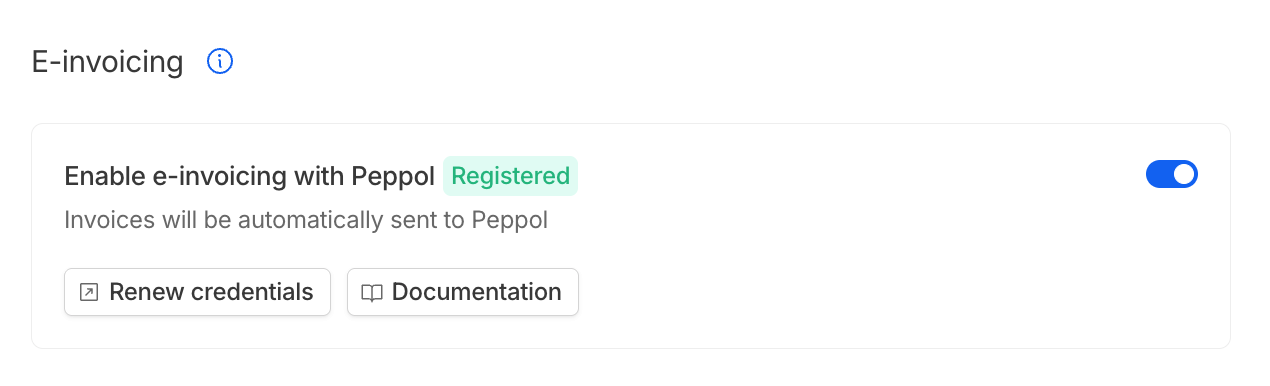
Switch on Enable e-invoicing
Some systems require pre-registration before starting the automatic
transmission of invoices. Click the Add credentials button to
provide the necessary information.
3
Click Save changes
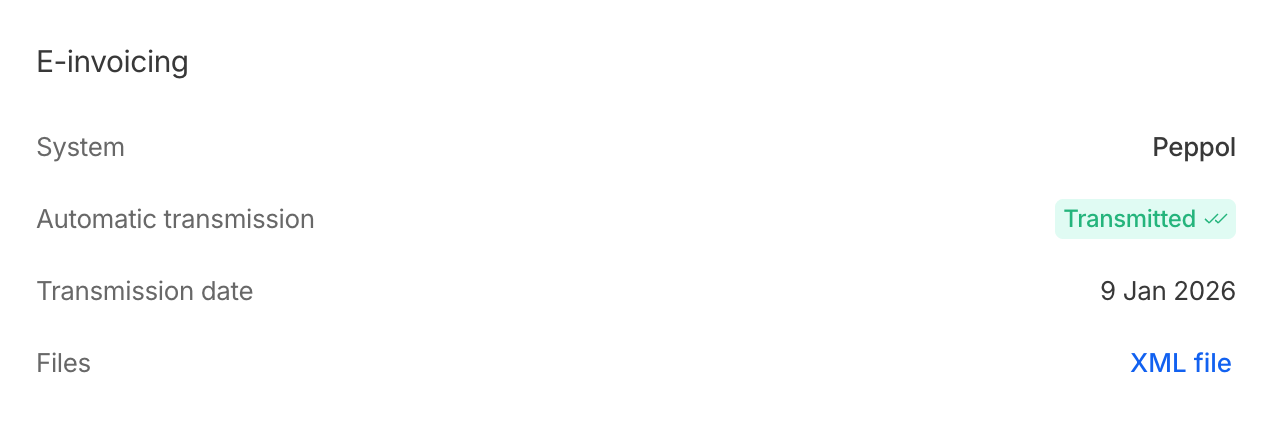
If automatic transmission is disabled for an invoicing entity, invoices show a “Not supported” transmission status instead of tracking the transmission progress.
Mark as transmitted
If you handled the transmission outside of Hyperline (for example, by uploading the e-invoice manually to a tax authority’s portal), you can record this on the invoice. Its status then reflects reality, and downstream behavior treats it as transmitted. The Mark as transmitted action is available on the invoice detail page when the e-invoicing transmission status is Not transmitted or Failed. Use it when:- Your invoicing entity does not have automatic transmission enabled, but you have transmitted the e-invoice through another channel.
- An automatic transmission attempt failed and you completed it manually outside of Hyperline.
Marking an e-invoice as transmitted only updates its status in Hyperline. It does not send the invoice to any tax authority or e-invoicing platform. Make sure the invoice has actually been transmitted before using this action.
Export e-invoices
To download the generated PDF and XML e-invoice files for several invoices at once, use the e-invoice export from the invoice list.Customer notification
When e-invoicing is enabled and the invoice is eligible for automatic transmission, Hyperline sends the “Invoice to pay” email notification when the invoice is transmitted to the e-invoicing system. It does not send it when the invoice is issued. This email indicates to the customer that the invoice has been transmitted and is ready to be paid.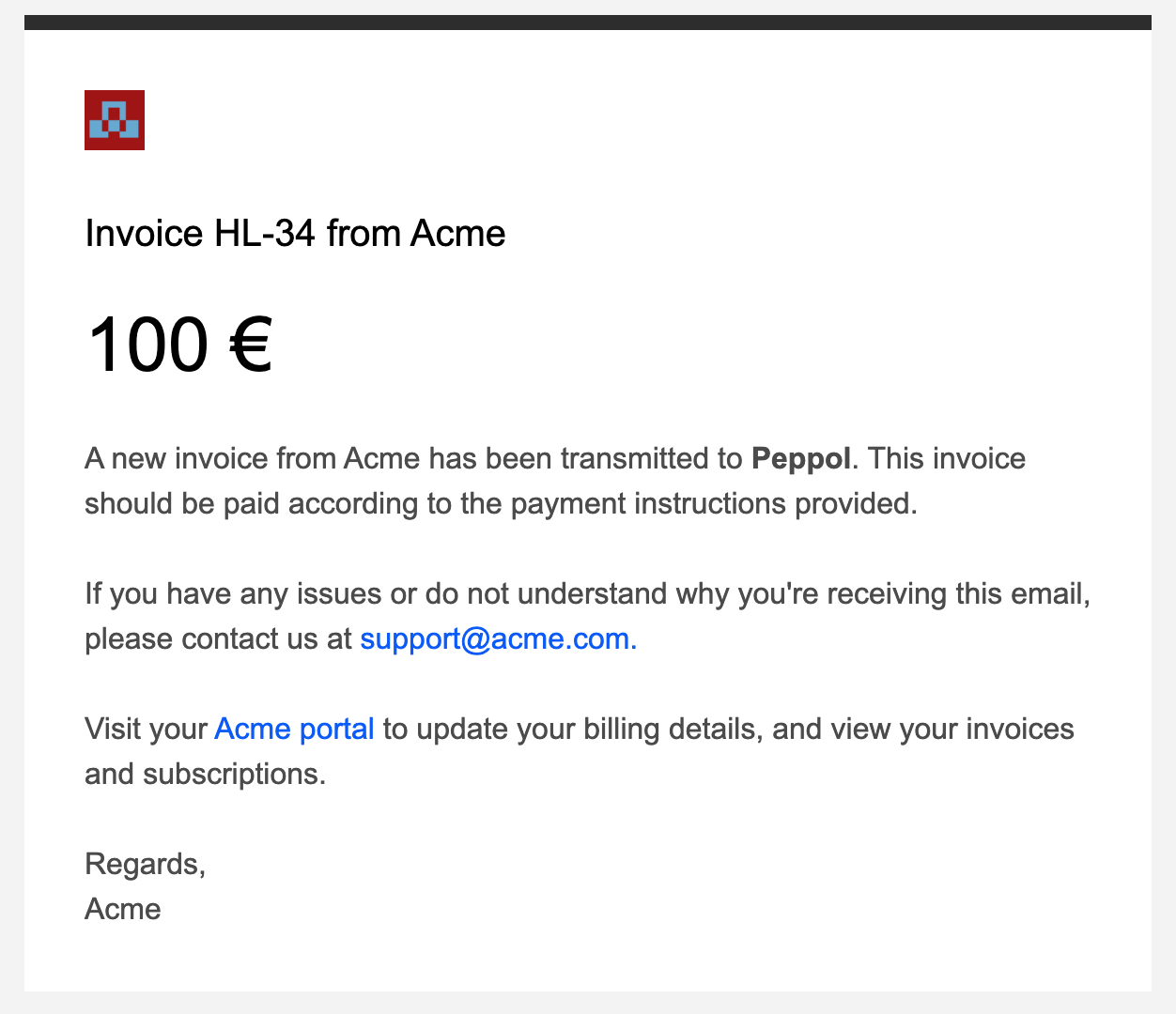
Example of email