

Export flow
1
Click the Export invoices button
On your invoices page, click the Export invoices menu in the top-left corner, then select Export invoices.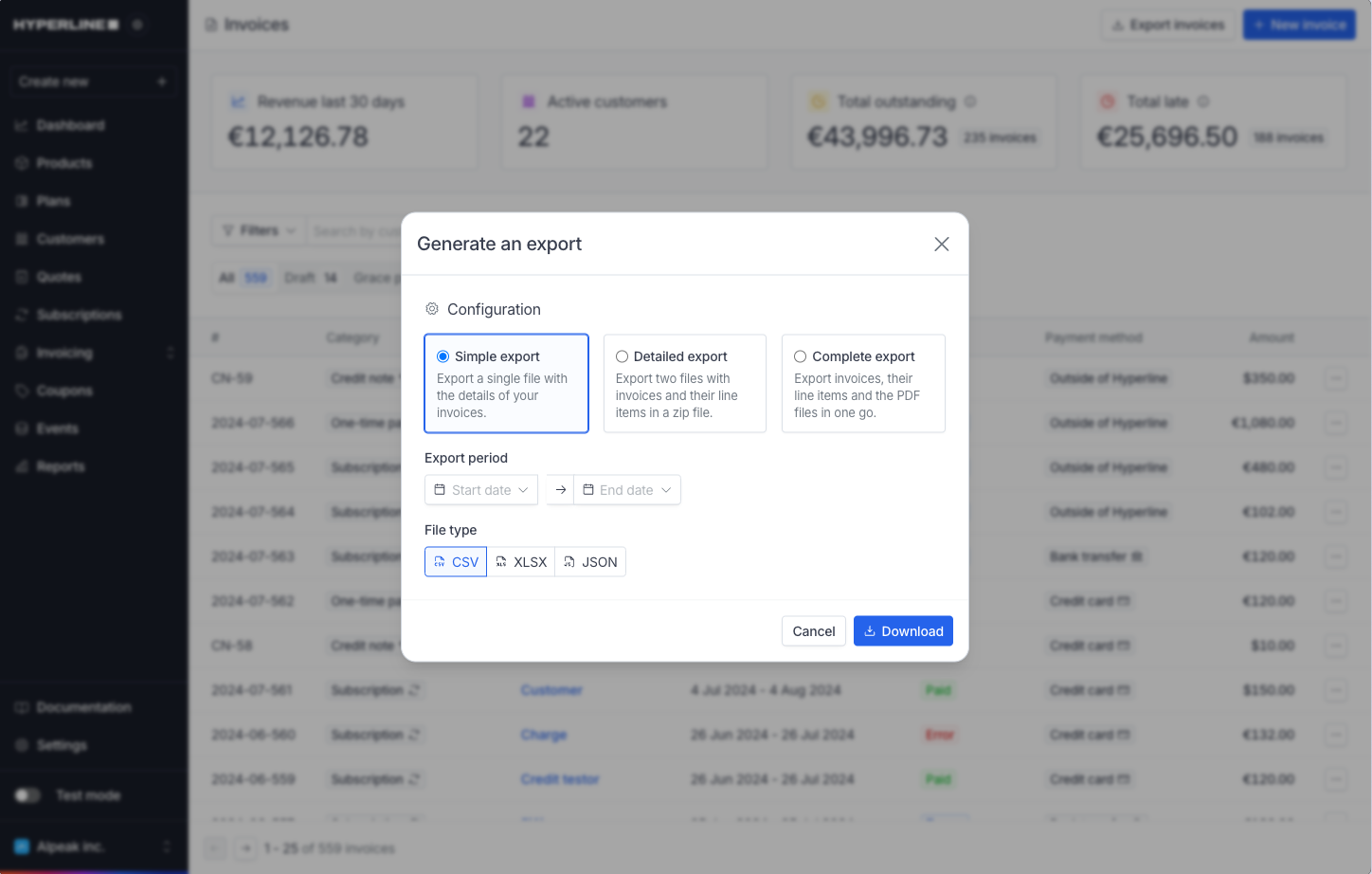
2
Select the type of export
Hyperline provides three export types:
- Simple export: Export a single file with the details of your invoices.
- Detailed export: Export two files with invoices and their line items in a zip file.
- Complete export: Export invoices, their line items and the PDF files in one go.
3
Select your export period
Select the start date and end date of data you want to export.
4
Select the format of the generated file
Hyperline provides CSV, XLSX, or JSON format.
5
Click Download
Hyperline automatically downloads a file with the related data.
E-invoice export
If you use e-invoicing, you can download the generated e-invoice files for a set of invoices in a single archive. Use this export to archive your e-invoices or share them with your accountant.1
Open the export menu
On your invoices page, click the Export invoices menu, then select Export e-invoices.
2
Select your export period
Select the start date, end date, and timezone of the invoices to export. The end date must be on or after the start date. The export also applies the filters currently set on the invoice list.
3
Click Download
Hyperline generates a ZIP archive containing:
- The available e-invoice PDF and XML files for the matching invoices.
- A status summary listing invoices whose e-invoice is missing or unavailable.
Large exports
Hyperline generates invoice exports asynchronously. On large workspaces or broad date ranges, the file can take longer to prepare before it is available to download. CSV exports are limited to 10,000 rows. If your export is too large, reduce the date range, export a narrower invoice set, use the public API for paginated extraction, or contact support for help with a bulk export.Amounts format
The exported amounts are represented in the currency’s smallest unit. For European currencies, this means that amounts are represented in cents. If you want to convert the exported amount into its decimals format you need to divide it by100. For example, an exported amount of 3417 (Euro, a two-decimal currency) will correspond to €34.17.
The same logic applies for zero-decimal currencies and three-decimal currencies. In this case, you need to apply the right multiplier (or none). For example, an exported amount of 12065 (West African CFA franc, a zero-decimal currency) will correspond to F CFA 12065.