

Overview
Hyperline offers a customer portal where your customers can get access to their live subscription, payment methods, billing information and invoices. The portal gives your customers a transparent and well-organized billing summary.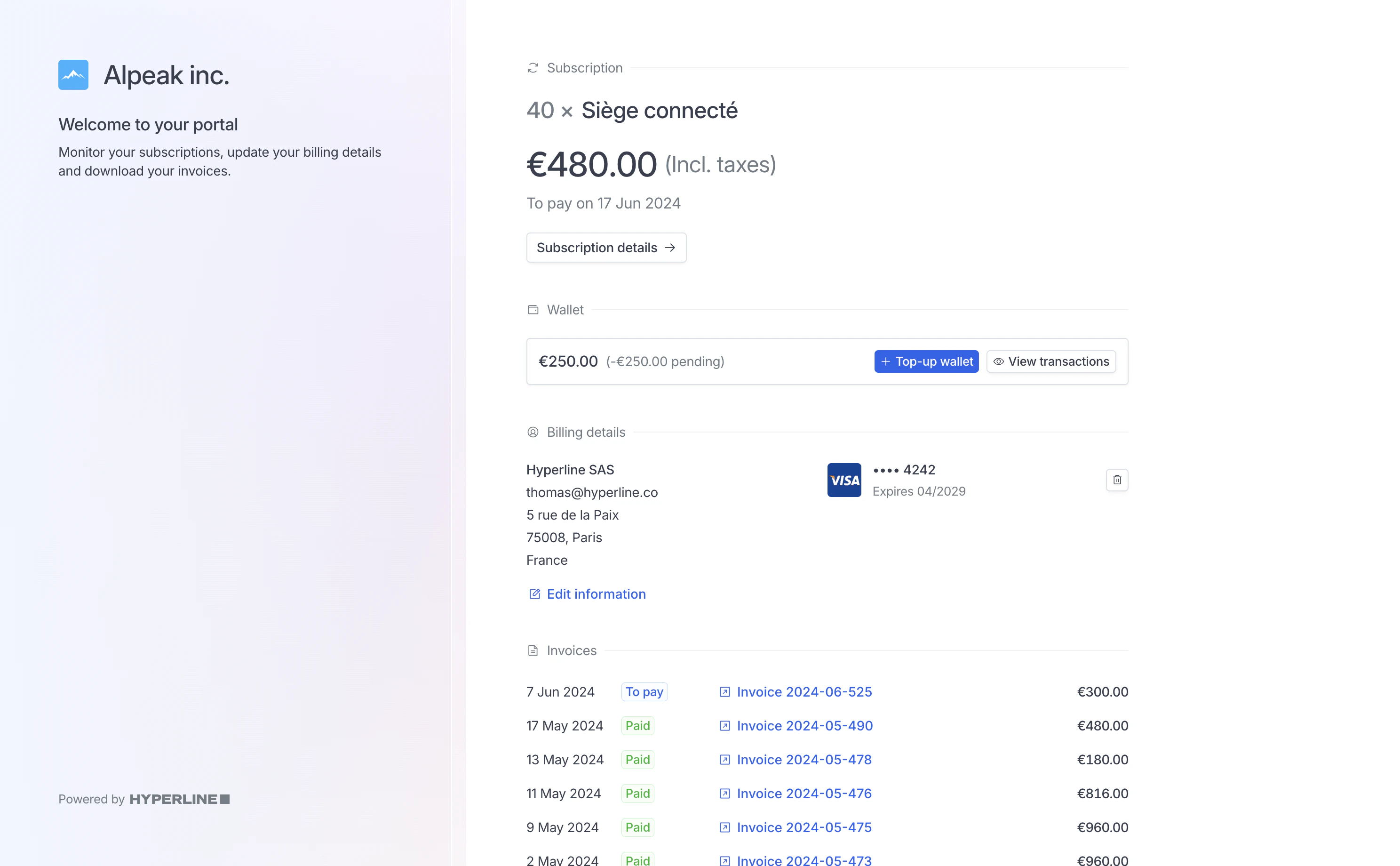
Portal language
Hyperline selects the portal language using these rules:- If the customer’s browser language is part of the 8 supported languages (English, French, German, Italian, Spanish, Polish, Portuguese and Dutch), the portal displays in that language.
- If it is not part of the supported languages, Hyperline defaults to the customer language selected on Hyperline customer information. By default, this language is inferred based on the customer’s country.
View subscription details
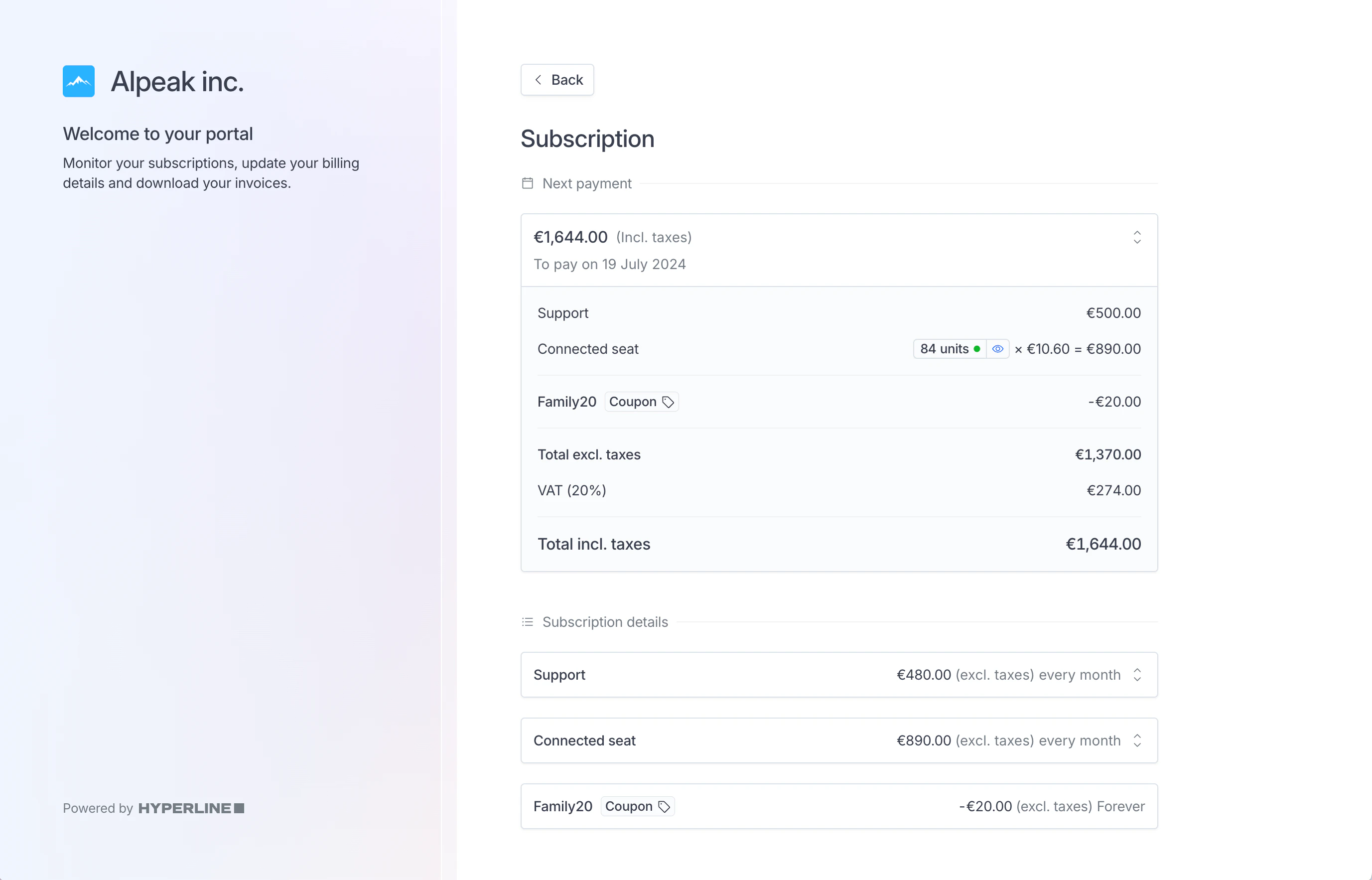
Customers can access the full details of their subscription by clicking Subscription details on the portal.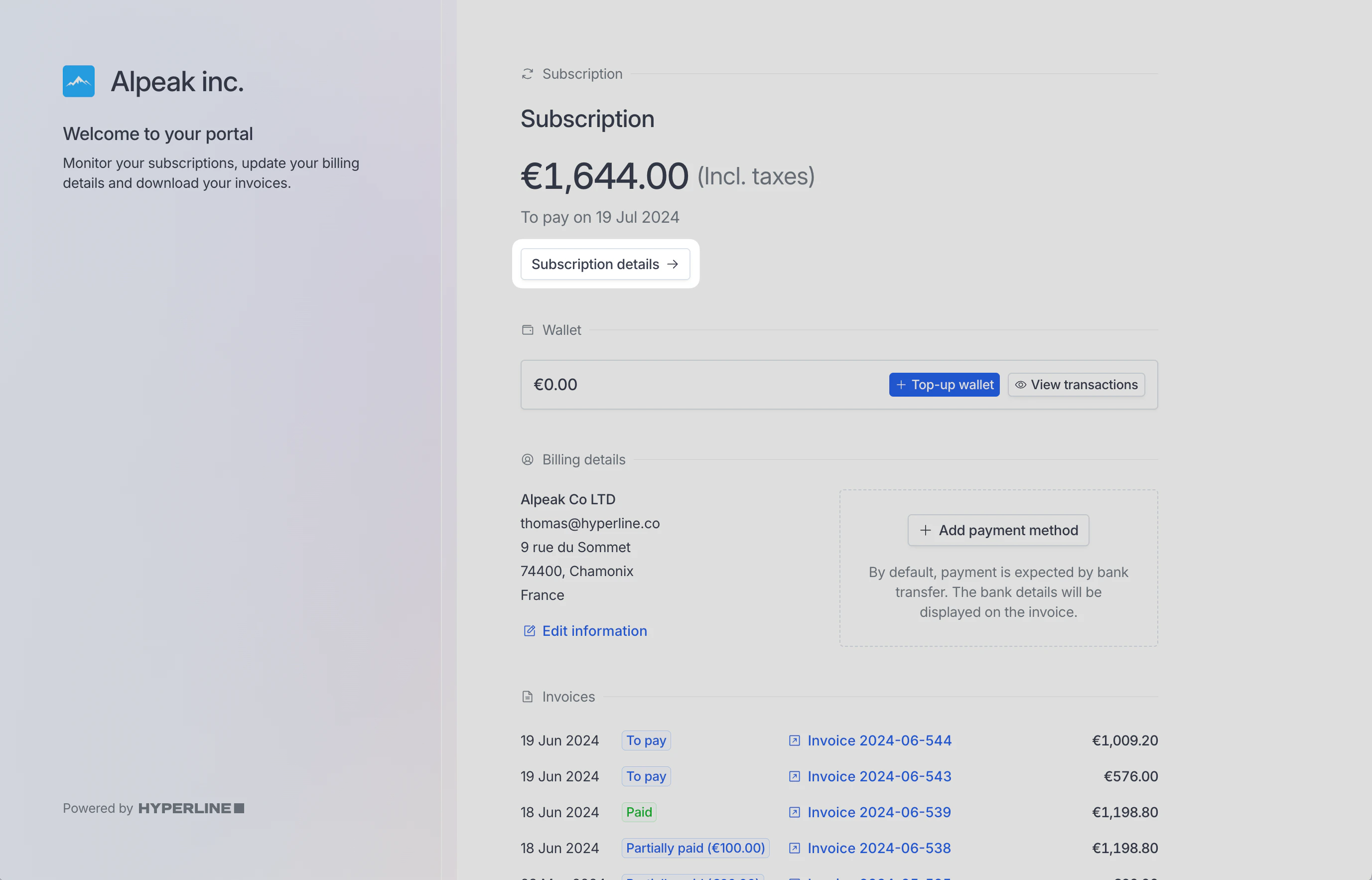
Change payment method
Customers can change their payment method by clicking the trash button next to their current payment method and adding the new one.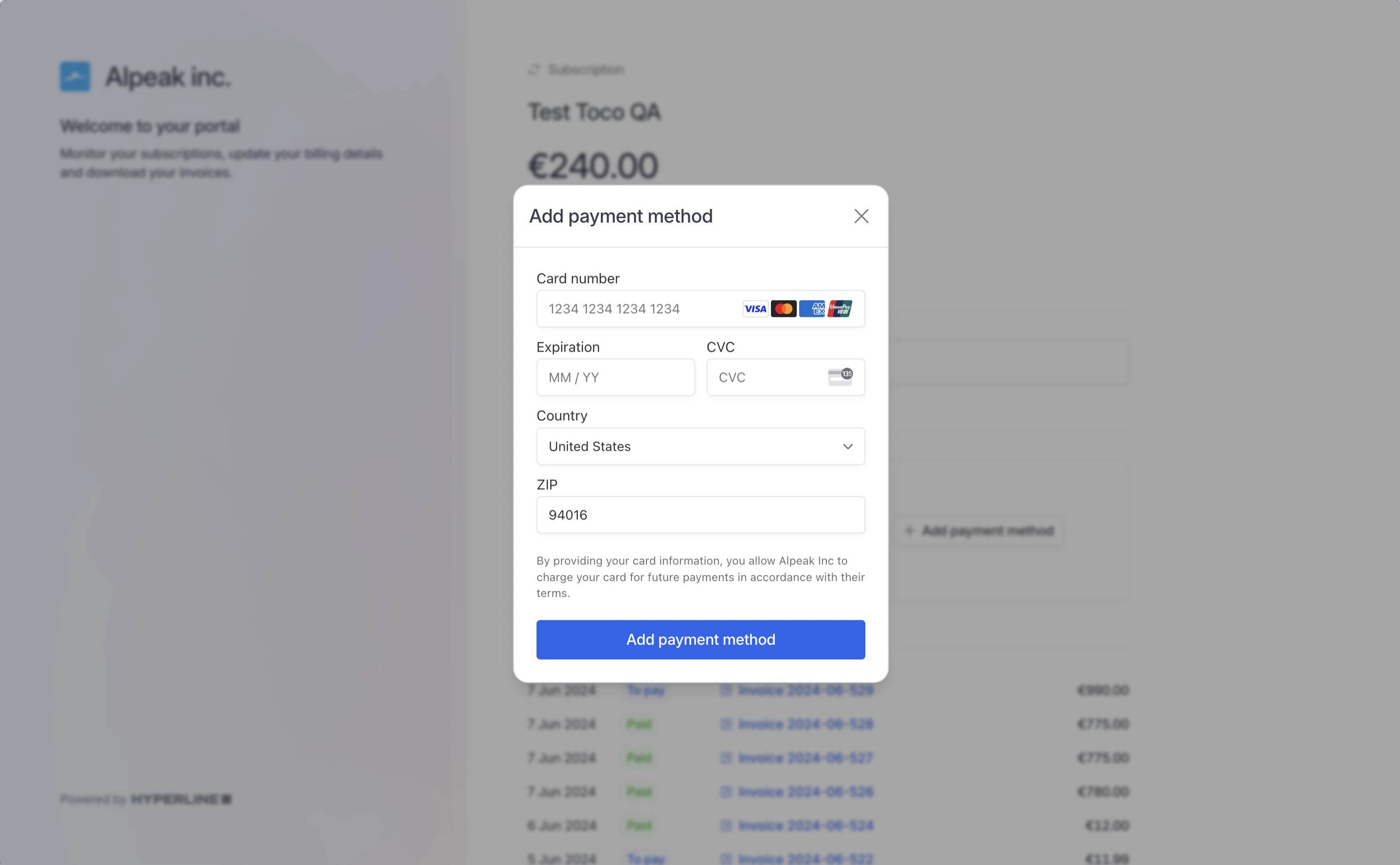
Top-up wallet
You can make your customers autonomous by letting them top up their wallet in the portal. For this, make sure you enable the option on the wallet settings first. Clicking Top-up wallet on this screen triggers an immediate payment from the registered credit card and credits the wallet instantly.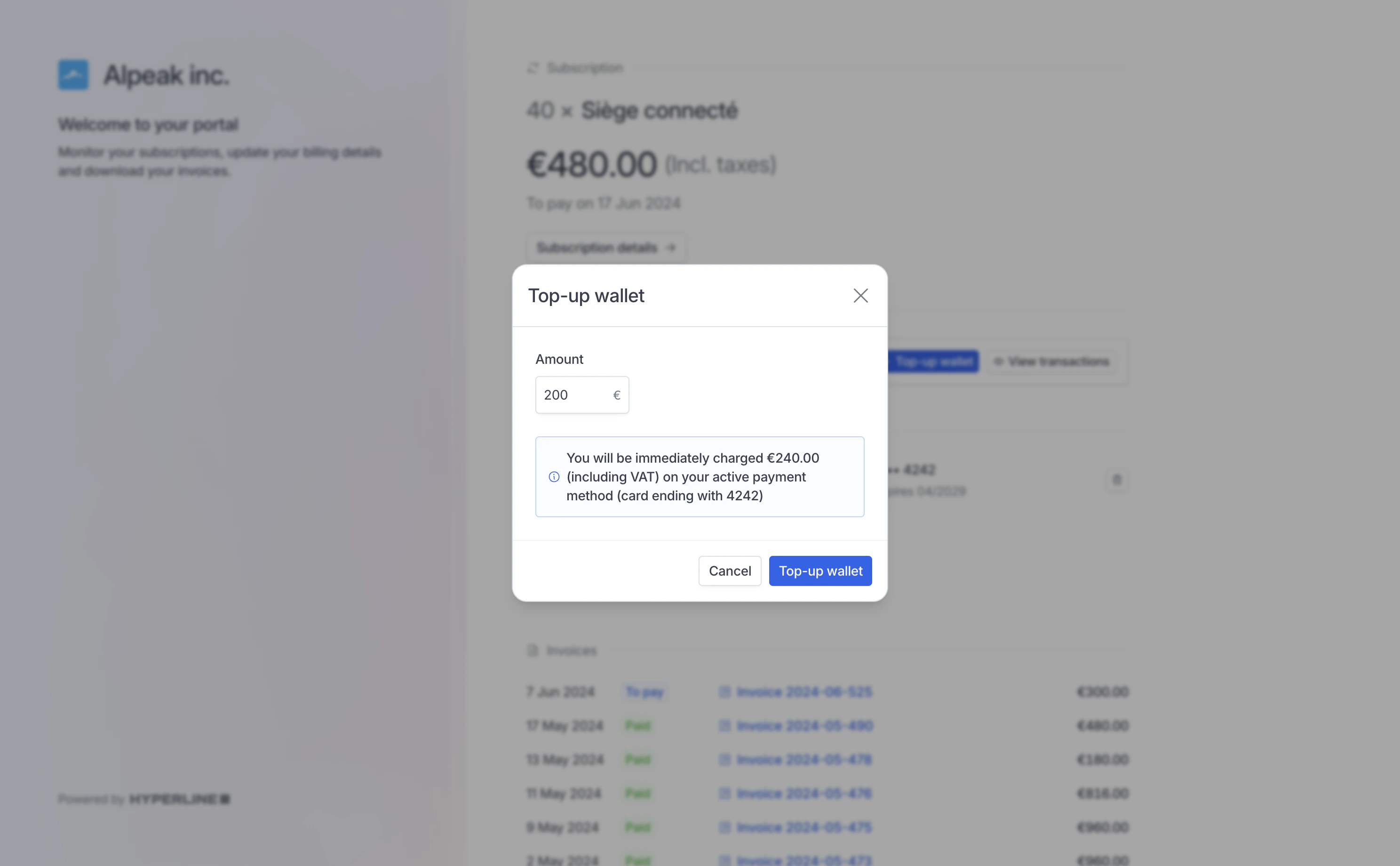
Edit billing information
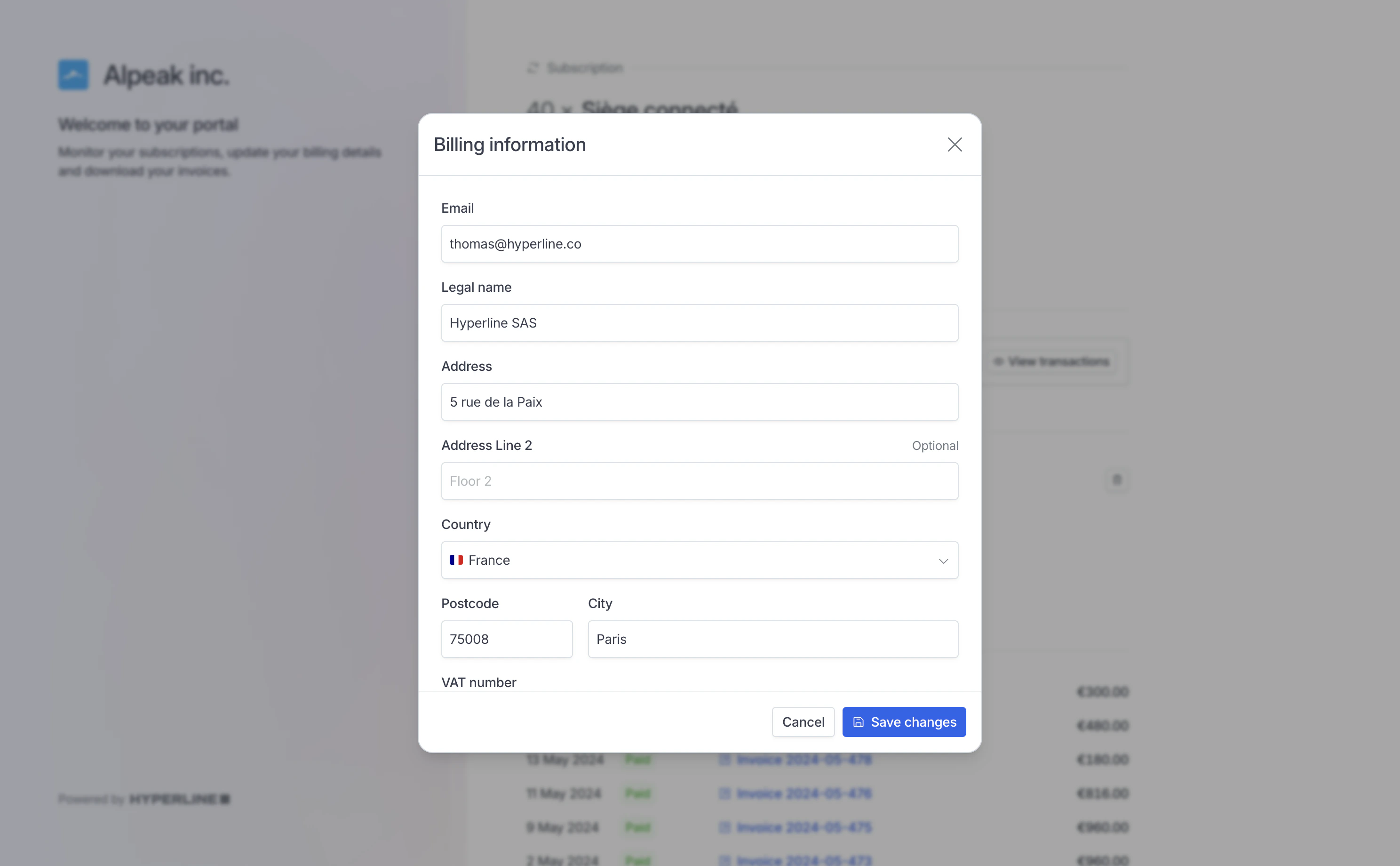
Customers can update their billing details by clicking the Edit button. This keeps their billing information accurate and up to date.You can control this capability in Settings > Hosted pages. See the Billing details update section below for more details.
Download invoices
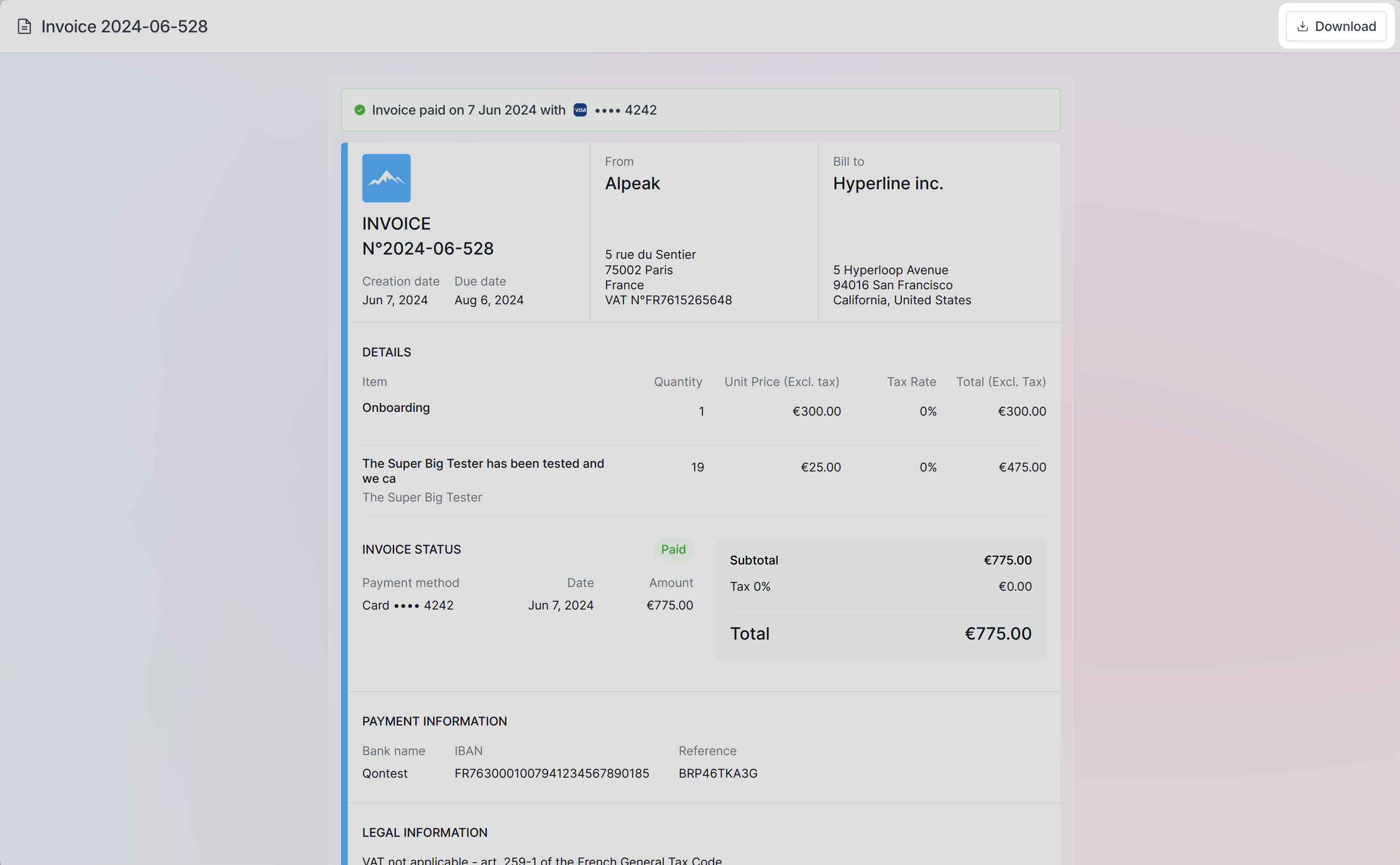
The portal lists all invoices, and customers can open each one on its dedicated invoice page.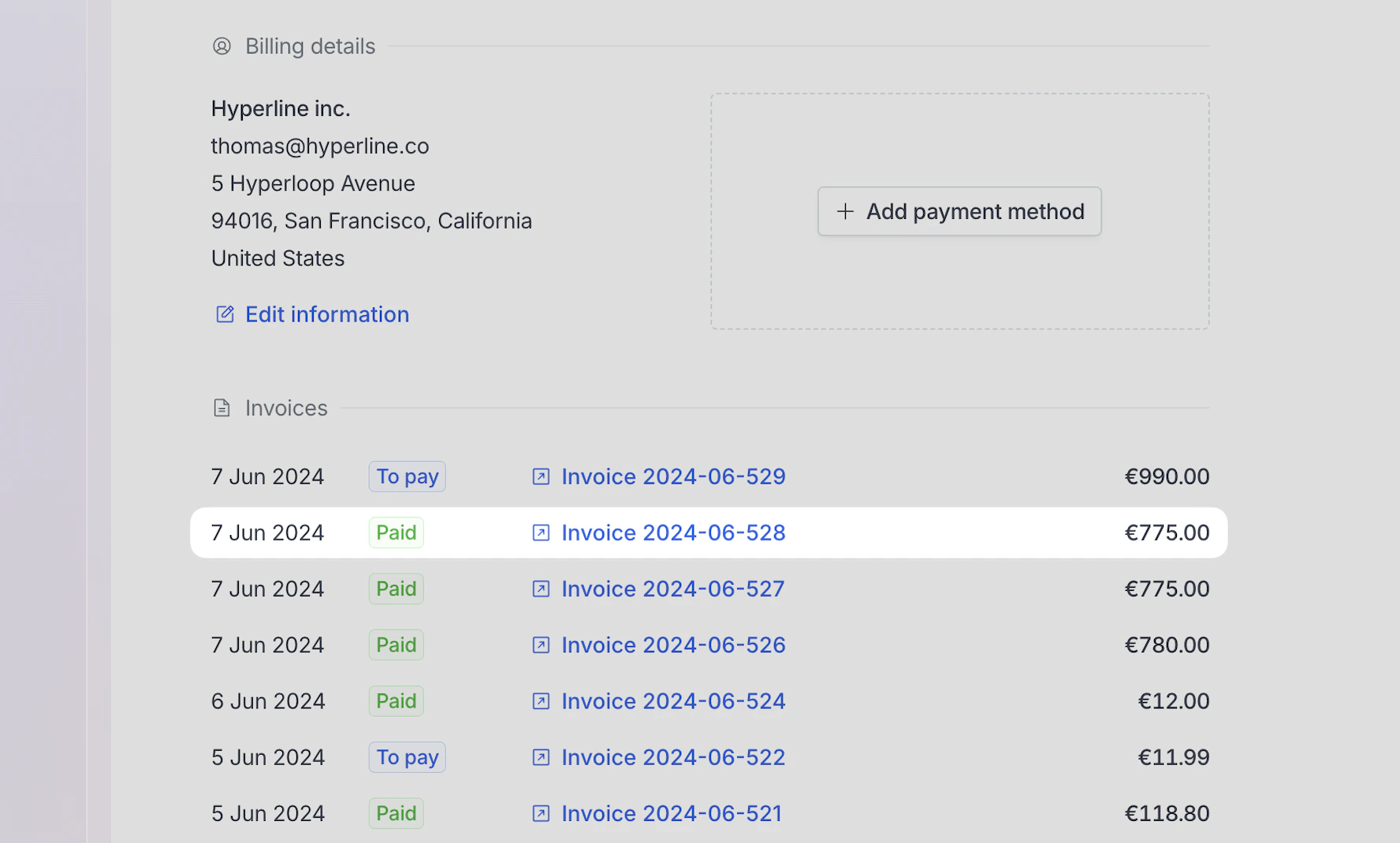
How to access the customer portal
To view the portal for a specific customer: go to the customer page, select the customer you want to view then click Portal.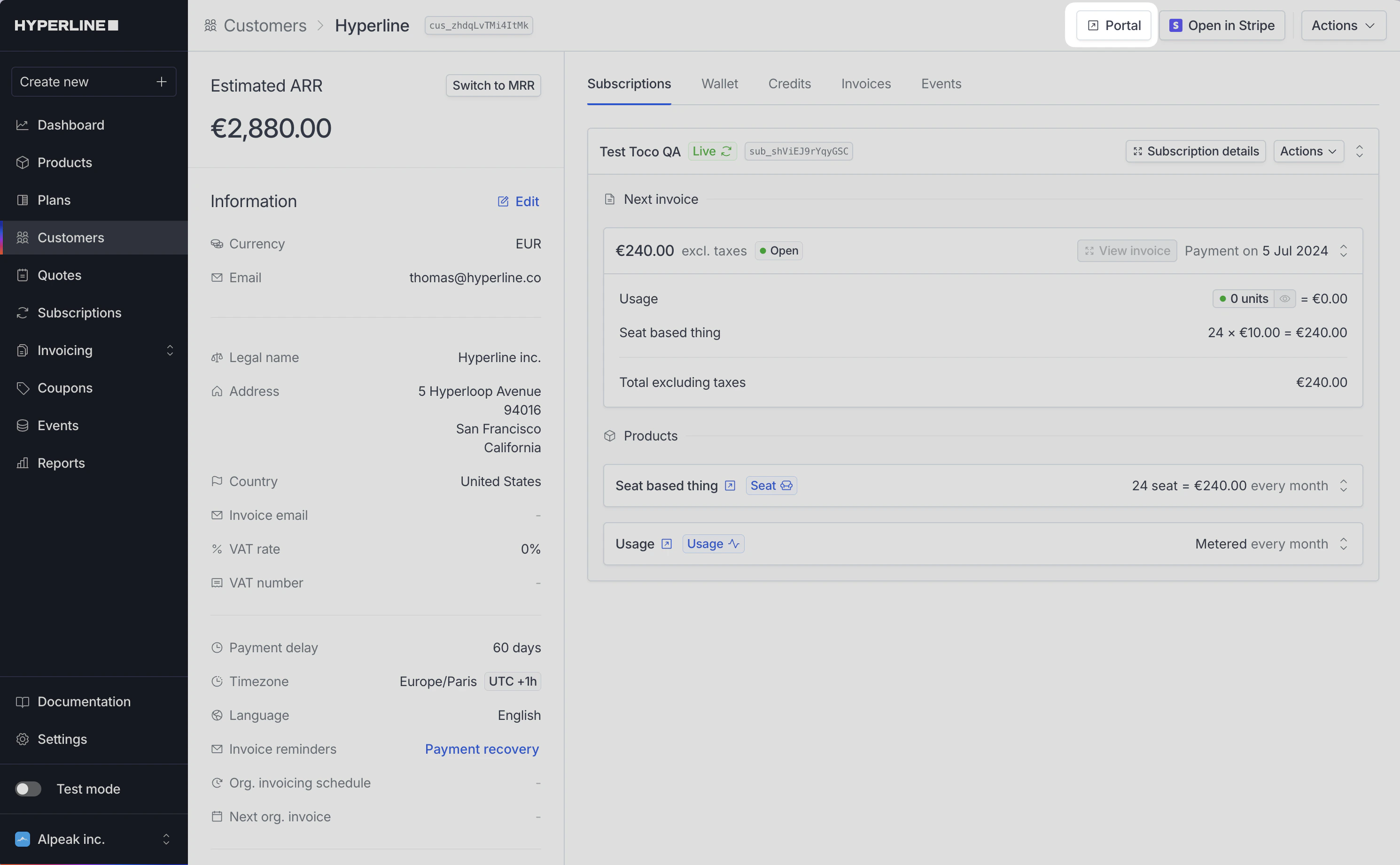
Customize the portal
Colors & brand identity
The portal adopts the primary brand color and icon that you configured in Settings under the General tab of Hyperline. This uses the same codes as those displayed on the invoice sent to your customers. This feature enables you to personalize your customer portal with the distinct colors and branding of your company.Set a custom domain
This domain controls the URLs of your hosted pages. To send customer emails from your own domain, configure a custom sending domain in Settings > Emailing > Sending.
CNAME record pointing to cname.hyperline.co on your DNS provider.
For example, if you set your custom domain to billing.alpeak.com in Hyperline and add the related CNAME record on your DNS provider, your portal and checkout URLs take this form:
Customer actions
You can control what actions customers can perform on hosted pages through Settings > Hosted pages under the Customer actions section:Billing details update
You can control whether customers can update their billing details on hosted pages. These details include billing address, billing email, tax identifiers, and invoice emails. In Settings > Hosted pages, under the Customer actions section, toggle Allow billing details update to enable or disable this capability. When enabled, customers can edit their billing information through the customer portal, checkout, and quote pages. The Local tax number field is available for company customers when it is enabled in the invoicing entity’s Taxes settings.Customer typology selection
By default, hosted pages (customer portal, checkout, and quote pages) allow customers to select between B2C (person) and B2B (corporate) typologies when updating their billing information. You can disable this typology selection in Settings > Hosted pages under the Customer actions section. When disabled, customers can’t change their typology on hosted pages, and the form uses their existing typology setting.Payment method deletion
You can control whether customers can delete their default payment method on hosted pages through Settings > Hosted pages under the Customer actions section. Toggle Allow payment method deletion to enable or disable this capability. Customers can always delete non-default payment methods, regardless of this setting. When deletion is disabled, customers can still delete a default payment method if it is irreversibly errored, meaning the card or mandate is permanently dead and cannot be recovered. This covers the following error reasons:Expired: the card or mandate has expired.MandateInvalid: the mandate is no longer valid.
InsufficientFunds, AuthenticationRequired, Declined, Fraud, Invalid, NotSupported, AuthorizationError, or Unknown) remain locked. The customer needs to retry or re-authenticate rather than delete the payment method.
Display options
You can control what subscription information is displayed on hosted pages through Settings > Hosted pages under the Display section.Hide contract duration
By default, subscription pages show contract details such as the contract start, commitment duration, and renewal terms. Toggle Hide contract duration in Settings > Hosted pages under the Display section to hide these details from the customer portal. Enable it when contract terms are managed outside Hyperline or could confuse customers.Generate a portal link
You can generate a portal link for a specific customer in two ways:- API: call
GET /v1/customers/{id}/portalto retrieve the portal URL. See the endpoint reference. - App: click the Portal button on the customer page (see How to access the customer portal).
Portal authentication
You can require customers to authenticate before accessing the customer portal through Settings > Hosted pages > Security. When enabled, customers without a valid token must verify their identity via a magic link sent to their email address before they can view their portal.How it works
Portal links contain an authentication token. Link expiration delay controls how long that token is valid; Require customer authentication controls what happens when no valid token is present. When authentication is required and a customer opens the portal without a valid token (first visit, expired token, or direct URL):- The portal shows a login screen.
- The customer enters an email matching their billing email or invoice emails.
- Hyperline sends a magic link to that email.
- Clicking the magic link grants access: indefinitely if no link expiration is set, otherwise for the configured window.
Portal authentication adds an extra layer of security by ensuring only authorized users can access customer billing information. This is useful for B2B customers where multiple people might share portal links.
Authentication vs. link expiration
Portal authentication and Link expiration delay combine to control access:- Auth off, no expiration: portal links work indefinitely (default).
- Auth off, expiration set: links work for the configured window. After expiry, the portal shows a link-expired page, without a login screen. Customers need a new link to access it.
- Auth on, no expiration: customers without a valid token are sent to the login screen. After authenticating via magic link, the issued token never expires (one-time auth, permanent access).
- Auth on, expiration set: links work for the configured window. After expiry, customers must re-authenticate via magic link to obtain a new token.
When authentication is required, every visit without a valid token redirects to the login screen. Communicate this to your customers if you change the setting.
Link expiration delay
By default, hosted page URLs (customer portal, checkout, and quote pages) contain authentication tokens that never expire. You can configure an expiration in Settings > Hosted pages > Domain > Link expiration delay (in minutes). When set:- Tokens are included in all hosted page URLs (both Hyperline-hosted and custom domain URLs).
- After the delay, customers need a new link or must re-authenticate to access the page.
- Applies to portal links, checkout session links, and quote links.
Link expiration enhances security by limiting how long a shared link remains valid. This is useful when you send links via email or other channels where they might be forwarded.
Set a redirect button
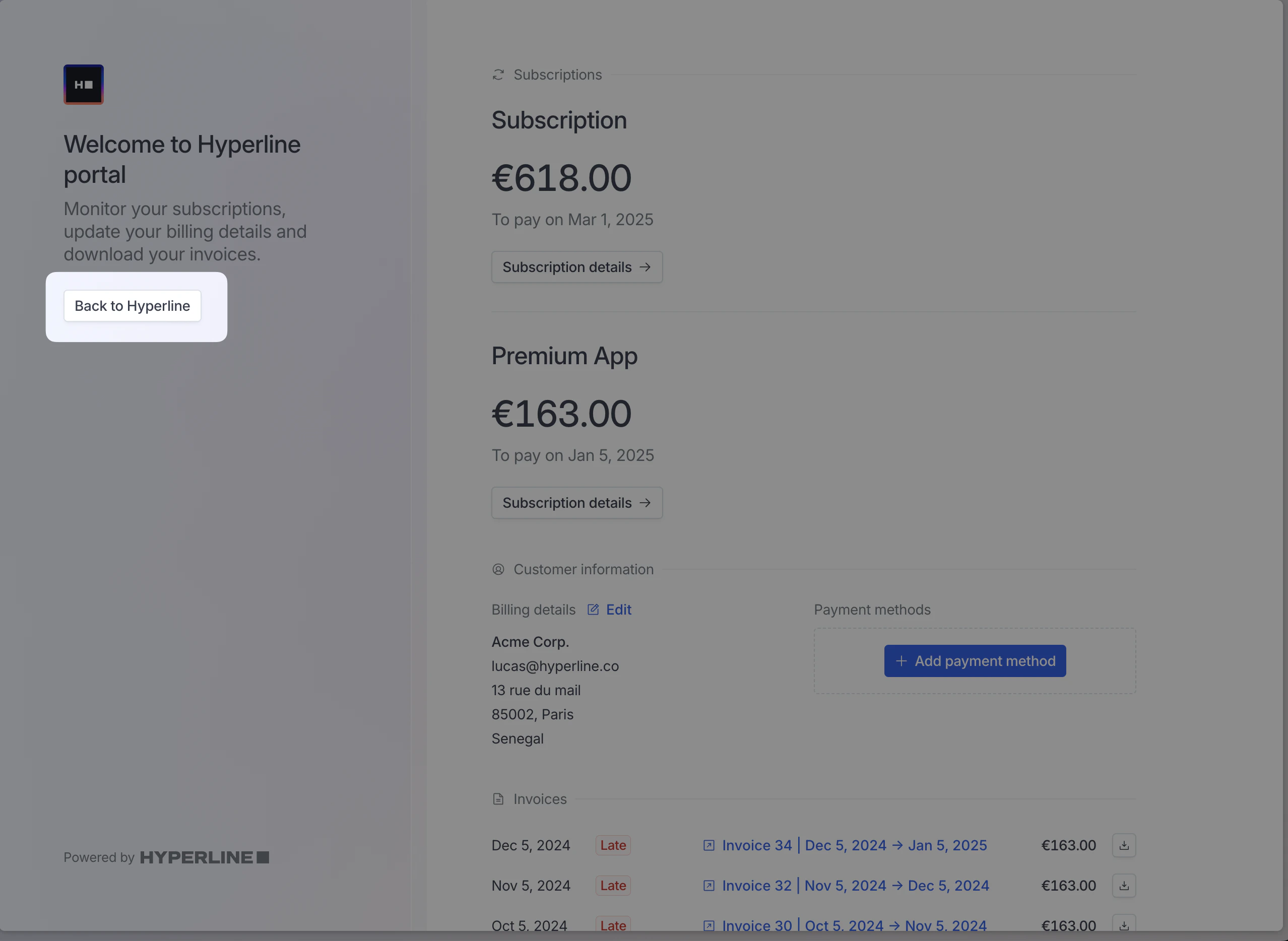
You can configure a back button in the hosted pages settings.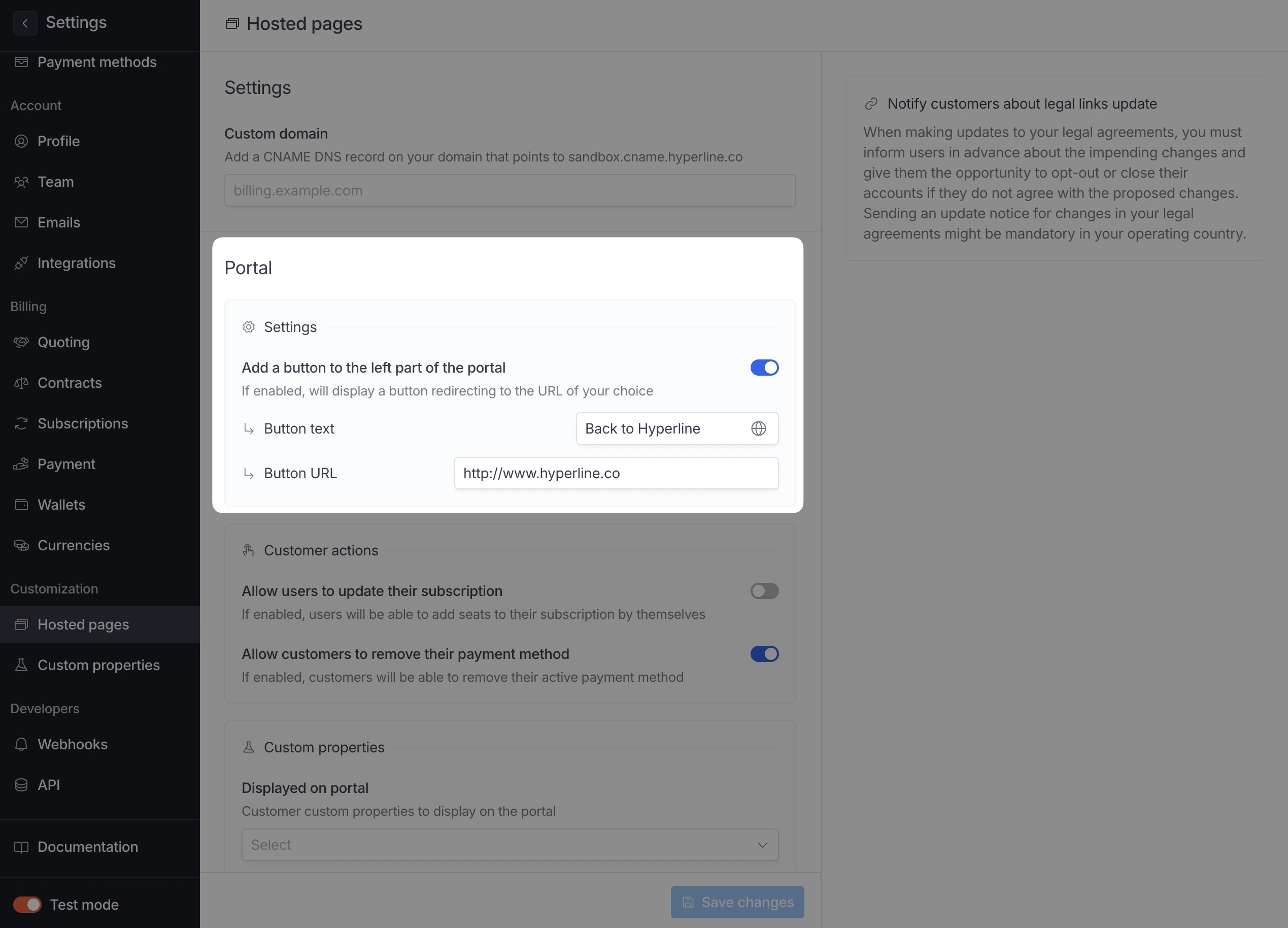
Display personalization
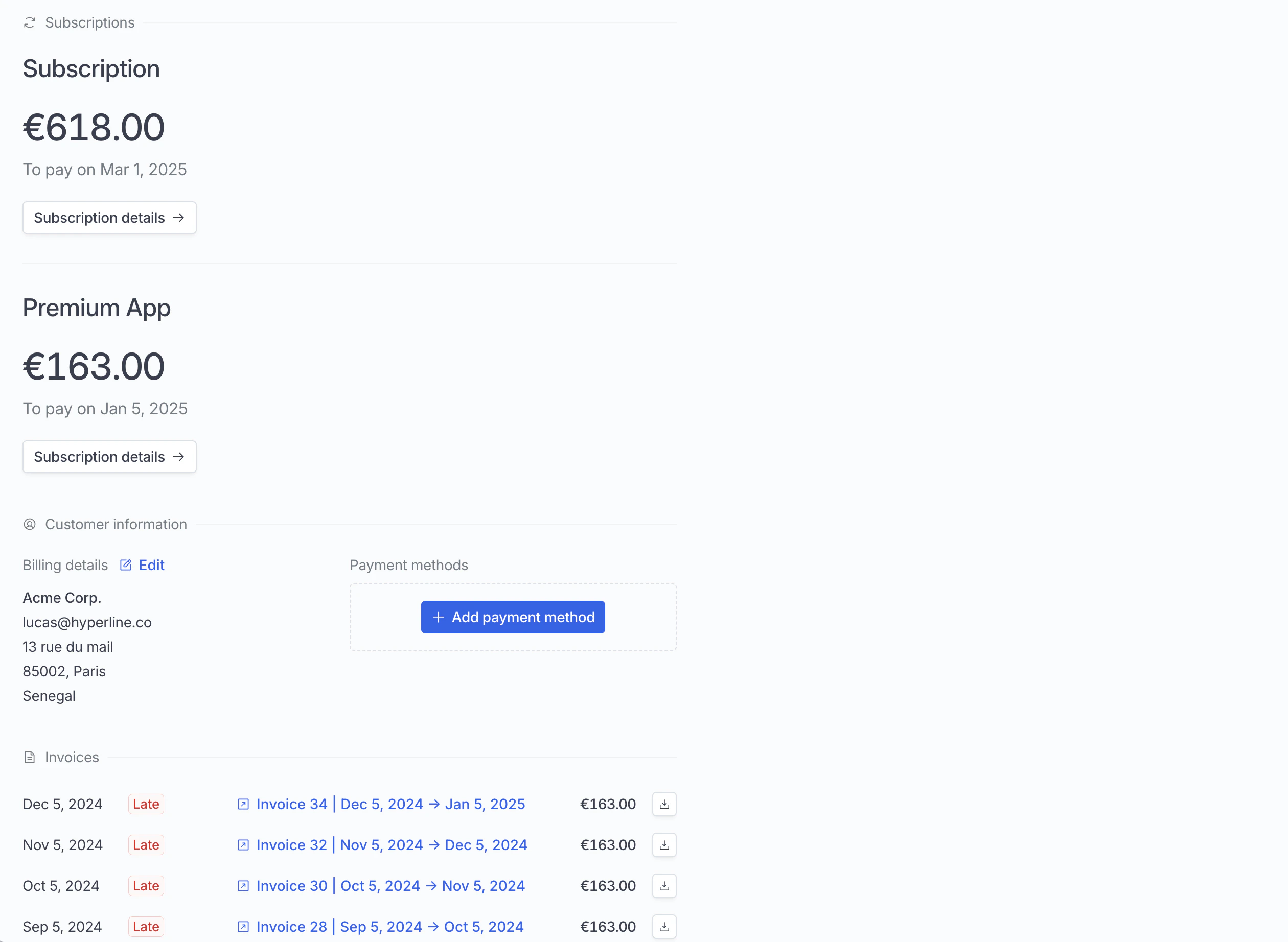
To hide the sidebar, add the&hideSidebar=true query parameter to your portal URL. The portal looks like this:
Embed the customer portal in an iframe
You can embed the Hyperline customer portal inside your application using an<iframe>.
Always add the allow="payment" attribute to your iframe:
payment permission. Without this attribute, wallet payment buttons don’t appear for your customers. Card payments still work.
This also applies if you embed Hyperline checkout, quote, or payment pages in an iframe. If you use the React SDK, the permission is set automatically. Make sure you run a recent version of
@hyperline/react-components.- https://app.hyperline.co (Portal UI)
- https://internal.hyperline.co (API calls within the iframe)
- https://api.hyperline.co (Public API calls)
- https://sandbox.app.hyperline.co
- https://sandbox.api.hyperline.co
- https://sandbox.internal.hyperline.co