

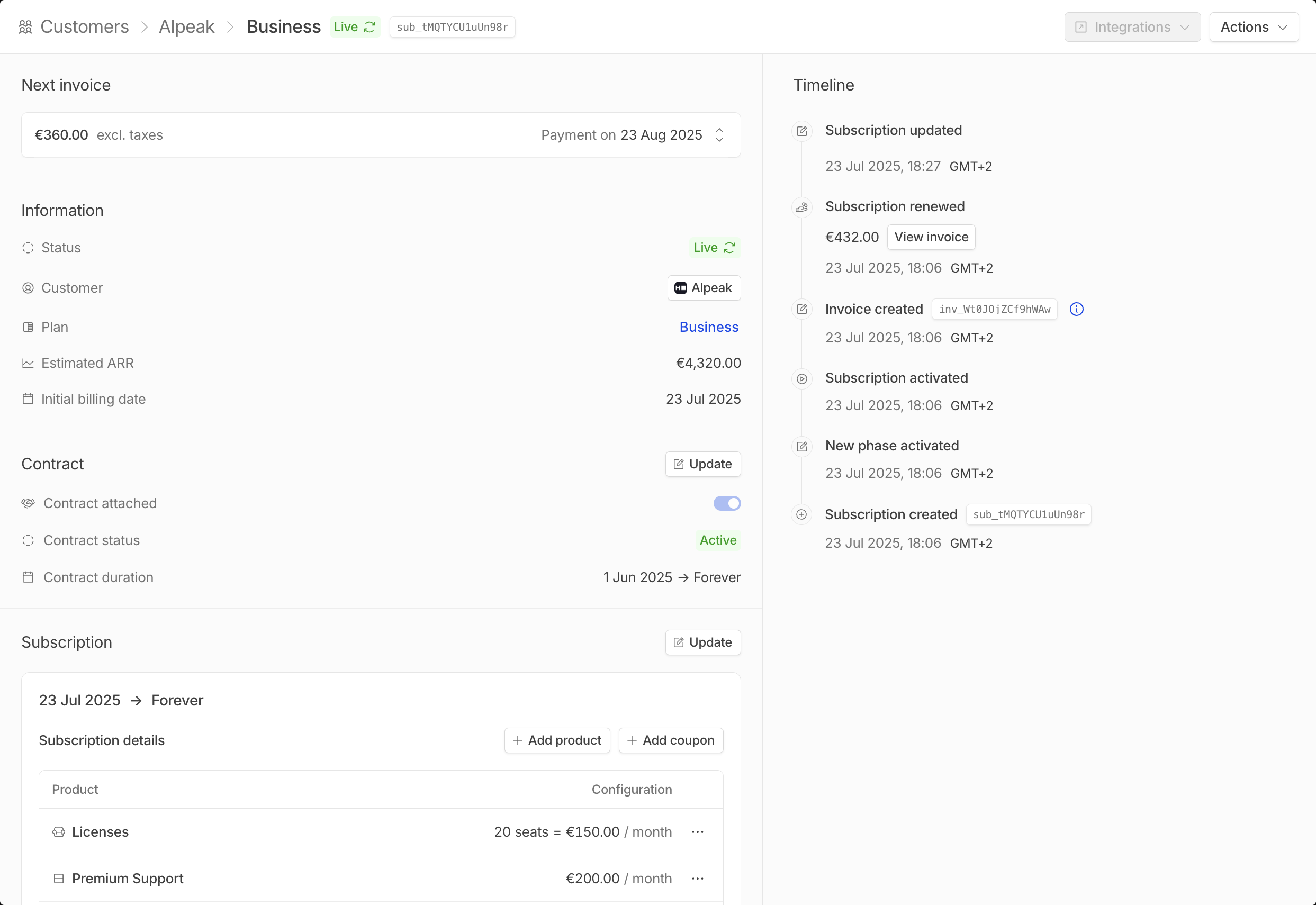
- Global update where you can update the whole subscription directly
- Local update where you can update a single part of the subscription (product price, contract configuration…)
You can’t update a subscription that is in a future state after generating future invoices. You also can’t update a subscription that has a quote for subscription update pending signature. You can still create additional update quotes in that state. The quotes tab of the subscription details page lists all open update quotes. For cancelled, voided, or archived subscriptions, you can only update simple fields (contract value, estimated ARR, CRM opportunity ID, and shipping details display).
Global update
You can update a subscription by clicking Update subscription in the subscription action dropdown. Hyperline then shows the following options:Simple update
When you select this option, Hyperline updates the subscription immediately, keeps the billing intervals, and does not generate a pro-rated invoice.Use this option when updating product information or adding, removing or updating a product or coupon without impacting the current billing period.
Advanced update
When you select this option, you enter a multi-step process to configure exactly when and how Hyperline applies the update, as well as manage the transition invoice precisely:1
Select when to apply the update
Select when the subscription update should take effect: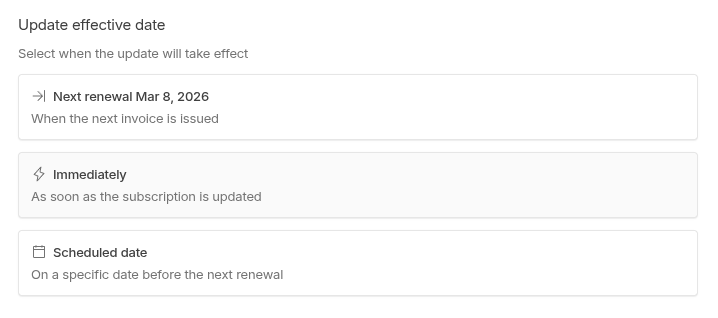
- Next renewal: Hyperline applies the update when the current billing cycle ends
- At last renewal: Hyperline applies the update retroactively as of the start of the current billing cycle
- Immediately: Hyperline applies the update right away
- On selected date: Hyperline applies the update on the date you select
2
Select the update source
Decide how you want to configure the updated subscription: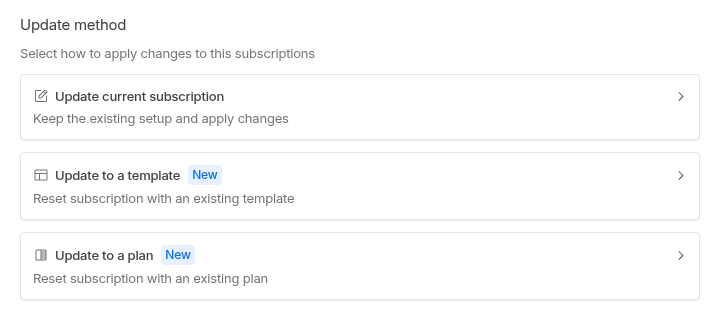
- Update current subscription: Modify the existing subscription configuration directly
- Update to a template or a plan: Reset the subscription configuration using a pre-defined template or plan as a starting point, which you can further customize if needed
3
Configure transition options
Define how Hyperline handles the billing cycle and invoicing during the transition:Billing alignmentTransition invoice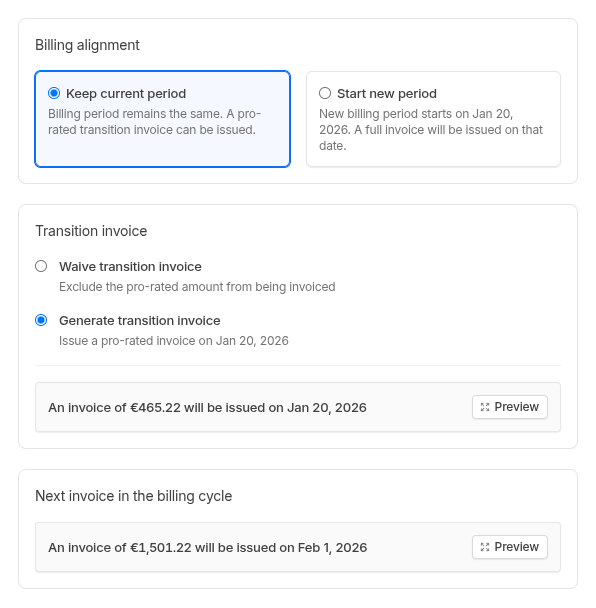
- Keep current period: The billing period remains the same. The next invoice keeps its original date.
- Start new period: A new billing period starts on the update date, which becomes the new renewal date.
Start new period isn’t available when the update applies on a renewal date (for example, Next renewal). Keep current period isn’t available when the new products have a different billing interval from the current ones.
- Waive transition invoice: Hyperline doesn’t issue any document for the transition. See Transition billing for what is billed later, which depends on the billing alignment.
- Issue transition invoice: Hyperline settles the previous configuration and charges the new one on a single document.
- Issue separate documents: Hyperline settles the previous configuration on one document and charges the new one on another. Available for updates At last renewal, or on every effective date when enabled on your invoicing entity (see the note below).
Issue transition invoice and Issue separate documents aren’t available when the subscription has products billing in a future period (for example, after using generate future invoices). You can still proceed with the update by waiving the transition invoice.
Separate documents on every update: by default, Hyperline nets the change into a single transition invoice. If your local invoicing rules or your accounting team require separate documents for the previous and the new configuration on every effective date (At last renewal, Immediately, and On selected date), contact support to enable it on your invoicing entity. Once enabled, Issue transition invoice is hidden for that entity. This is the default for Spanish invoicing entities.
Refunding transition credit notes: When the update creates a credit note, Hyperline follows the invoicing entity’s Refund credit notes to wallet by default setting. If the setting is disabled, Hyperline refunds payments made by card or direct debit to the original payment method, while credit notes for bank transfers remain open. Learn how to configure the default refund destination.
Transition billing
When an update applies during a billing period, Hyperline settles the previous configuration up to the update date and charges the new configuration from that date. What is billed depends on each product’s Schedule setting (Start of period or End of period) and on the options you select. Previous configuration, up to the update date:- Start of period products, already invoiced for the whole period, are credited for the rest of the period.
- End of period flat products are charged prorated up to the update date.
- Usage-based products are charged for the actual usage up to the update date.
- Start of period products are charged until the end of the current period with Keep current period, or for a full new period with Start new period.
- End of period and usage-based products are billed at the end of the period, as usual.
With Issue transition invoice, Hyperline removes lines that cancel each other out. The document is an invoice when its total is positive and a credit note when it’s negative. With Issue separate documents, each document follows its own total, so the document settling the previous configuration is an invoice when usage and End of period charges outweigh the credit.
At last renewal applies the update as of the start of the current period. With Issue transition invoice or Issue separate documents, Hyperline credits the lines already invoiced for the current period and invoices the period again with the new prices, on one document or on two.
Next renewal applies the update on the renewal date, with Keep current period. Nothing is left to credit, so with Issue transition invoice the transition invoice replaces the regular renewal invoice. It charges usage and End of period products for the period that just ended at the previous prices, and Start of period products for the new period at the new prices. With Waive transition invoice, Hyperline issues no transition document, and the regular renewal invoice charges usage and End of period products for the period that just ended at the new prices.
Waive transition invoice also skips billing for units added to one-off products that were already invoiced. With the other options, Hyperline bills these units.
Example 💡
A customer pays €300/month for a platform fee (Start of period) and €0.10 per API call (usage-based), renewing on the 1st. On April 16th, you apply an update Immediately that moves the platform fee to €450/month, with Keep current period and Issue transition invoice. The customer made 2,000 API calls between April 1st and April 16th.The transition invoice contains:
- A credit of €150 for the unused half of the €300 platform fee
- A charge of €200 for the 2,000 API calls made up to April 16th
- A charge of €225 for the €450 platform fee until April 30th
Scheduled updates
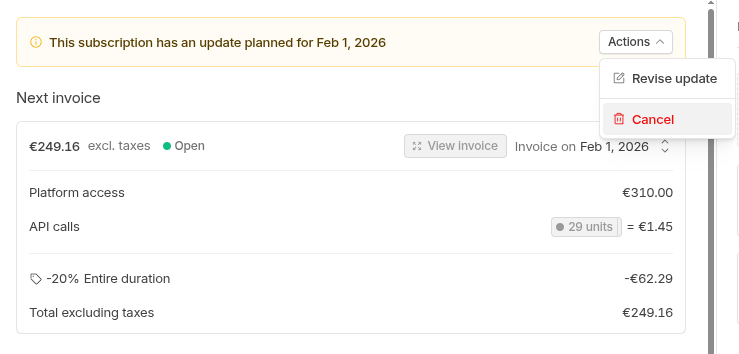
You can’t update a subscription with a scheduled update until the scheduled update is applied or cancelled. However, you can manage the scheduled update through the subscription dropdown:- Revise update: Edit the scheduled update configuration
- Cancel: Cancel the scheduled update entirely so you can update the subscription again
Subscription versions
You can access previous subscription versions, as well as scheduled updates, through the versions tab.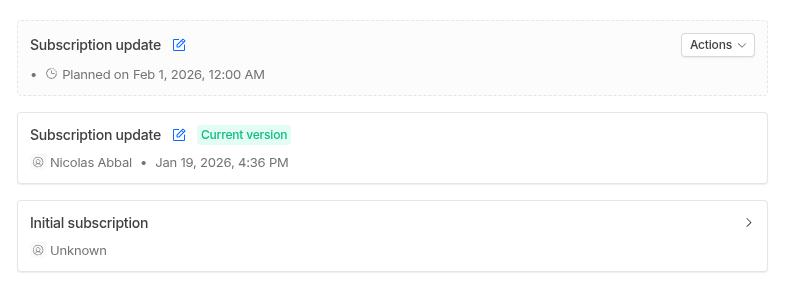
Local update
To update only a single part of the subscription instead of the entire subscription at once, use a local update.Duration
You can edit the subscription or phase end date to end at a later or closer date with the following options:- Forever
- After a custom relative duration
- At a specific date
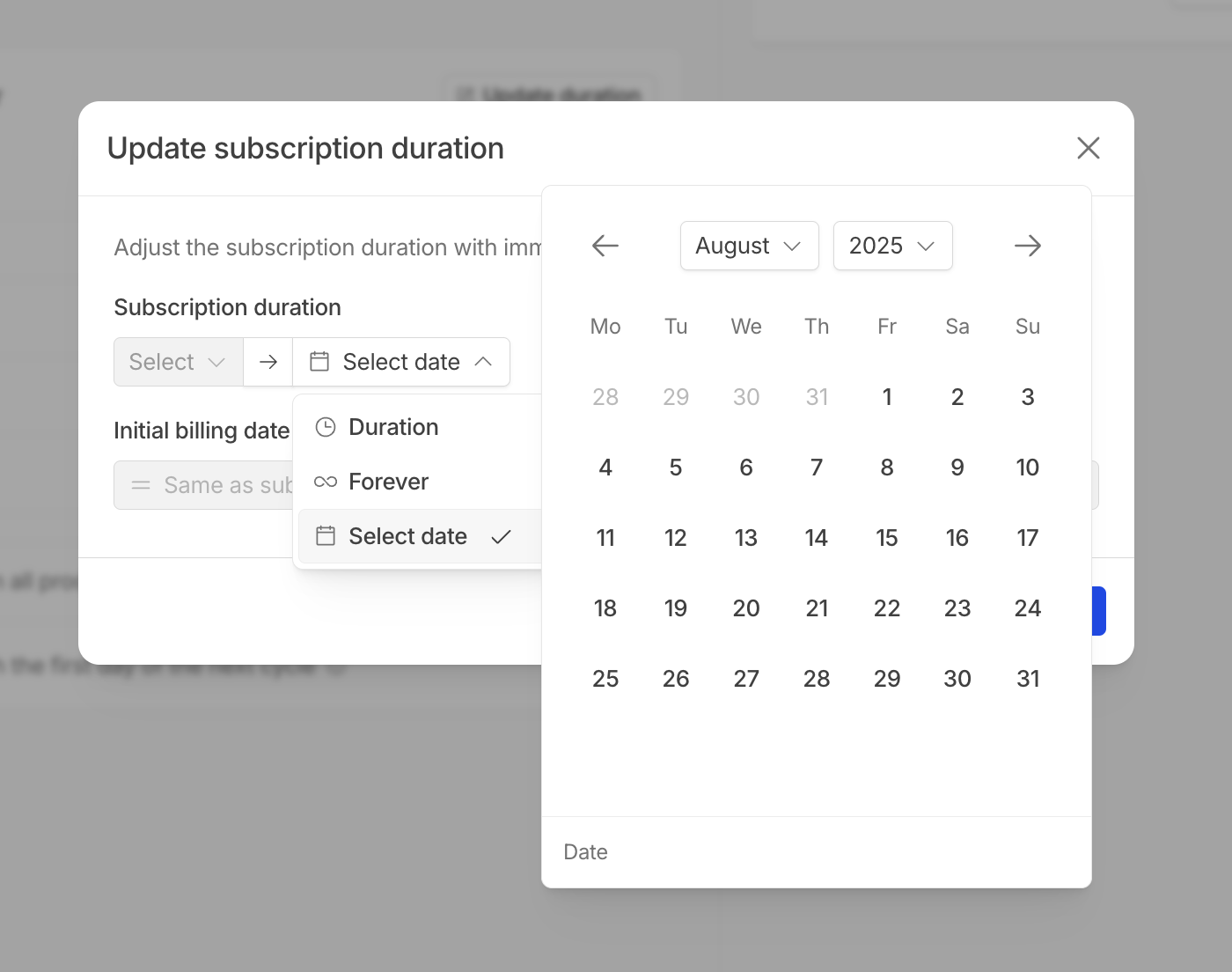
You cannot set the end of the phase or subscription before the end of the current billing period of its products. To do that, you need to cancel the subscription.
Products
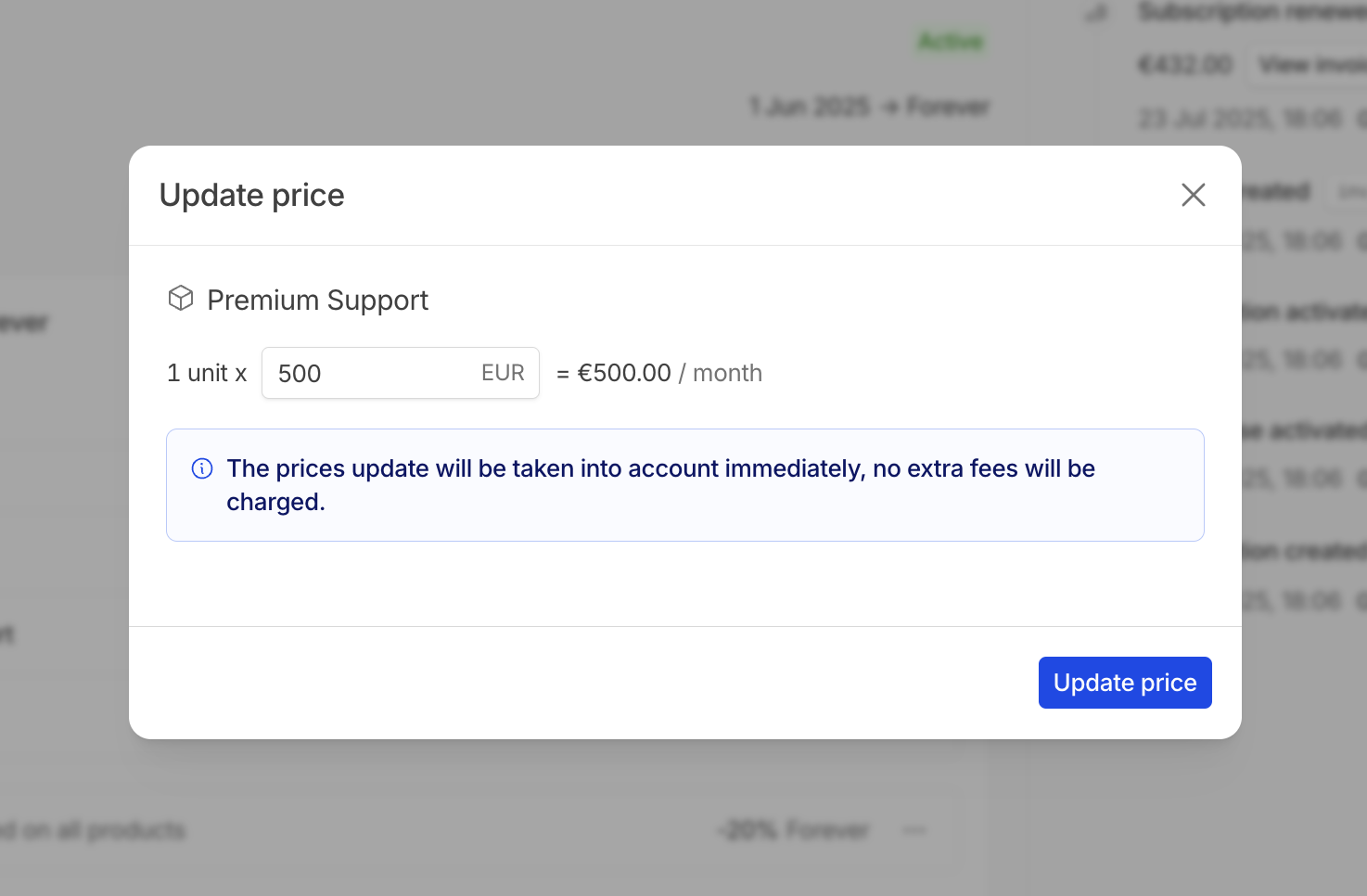
You can edit the price and quantity of products that currently belong to a subscription, and add or remove them freely.Update product price
You can edit prices immediately by clicking the product... then Update price. The price updates immediately and applies to the next invoice.
Update product quantity
You can edit the quantity (except for usage-based and connected seats) by clicking the product... then Update quantity.
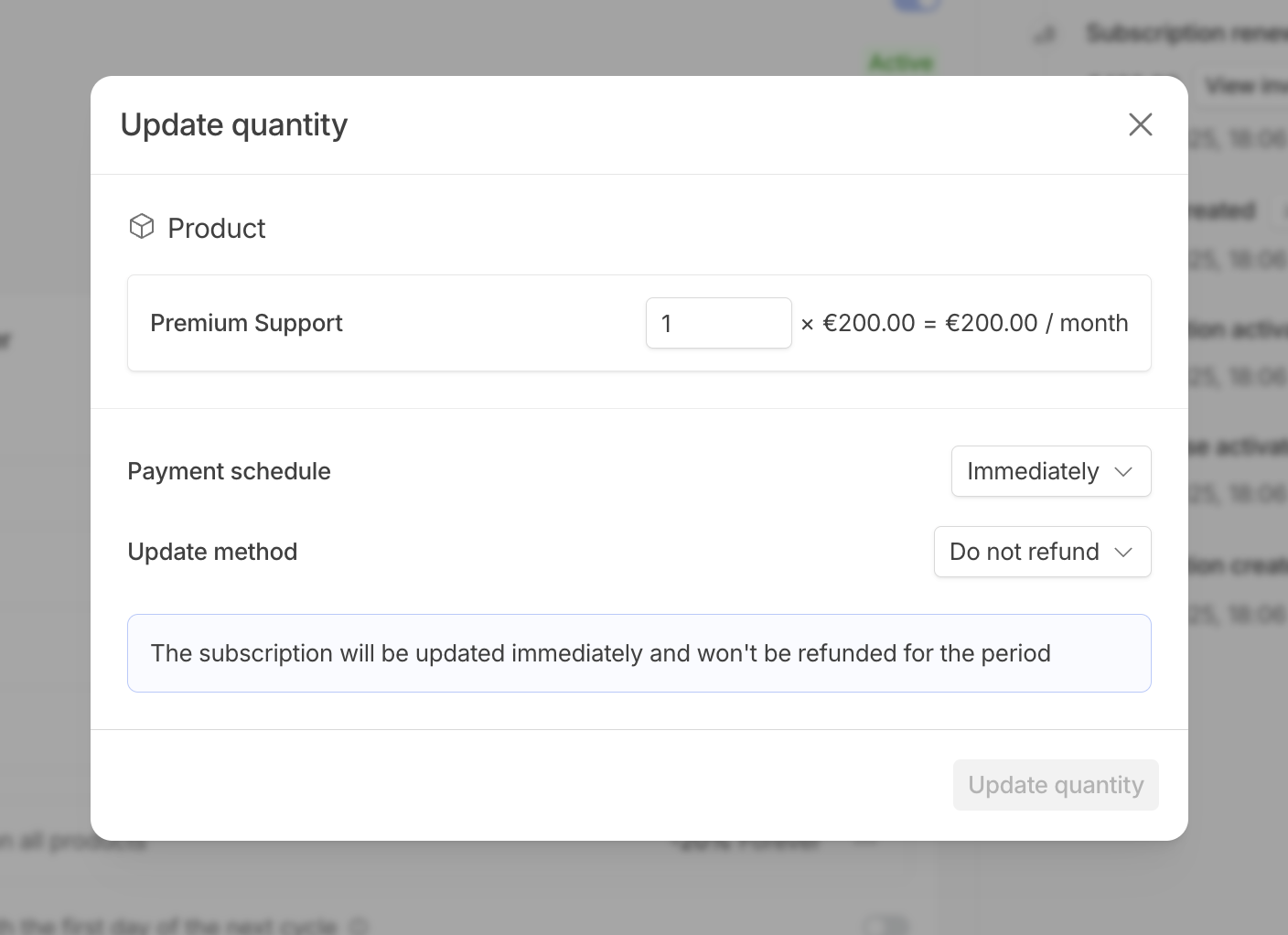
- Payment schedule sets when billing happens (not when the change applies):
- Immediately: Hyperline issues and charges a separate invoice (or credit note) right away.
- Next invoice: Hyperline adds the adjustment as a line on the next invoice.
- Update method sets how the adjustment is computed:
- Pro-rata: only the remaining or elapsed portion of the period.
- Full price: the full period amount.
- Do not charge / refund: apply the new quantity without any billing.
With Full price, Hyperline doesn’t produce an adjustment line for an end-of-period increase or a start-of-period decrease. For an increase, the regular end-of-period invoice bills the added quantity at full price. For a decrease, the customer already paid for the removed quantity in the current period.
- Immediately: Hyperline bills nothing and generates no invoice.
- Next invoice: Hyperline adds a zero-amount line to the next invoice to record the change (labelled as not invoiced for the period).
One-off products already invoiced
You can also update the quantity of a one-off product that Hyperline has already invoiced, except credit packs. For these products, the dialog hides Payment schedule and Update method. Hyperline charges only the added units, right away on a new invoice. Hyperline doesn’t refund removed units. In an Advanced update, the product keeps its Invoiced tag and you cannot change its price, but you can edit its quantity. When you issue a transition invoice, Hyperline bills the added units on it or on a separate invoice. The preview shows that separate invoice as Invoice for added one-off units. With Waive transition invoice or a Simple update, Hyperline updates the quantity without billing the added units.Add product
You can add products directly to a live subscription by clicking Add product. You can add products with an existing price configuration or configure them manually. Hyperline adds them to the subscription immediately. You can charge them at full price, pro-rata, or not at all, either immediately or on the next invoice.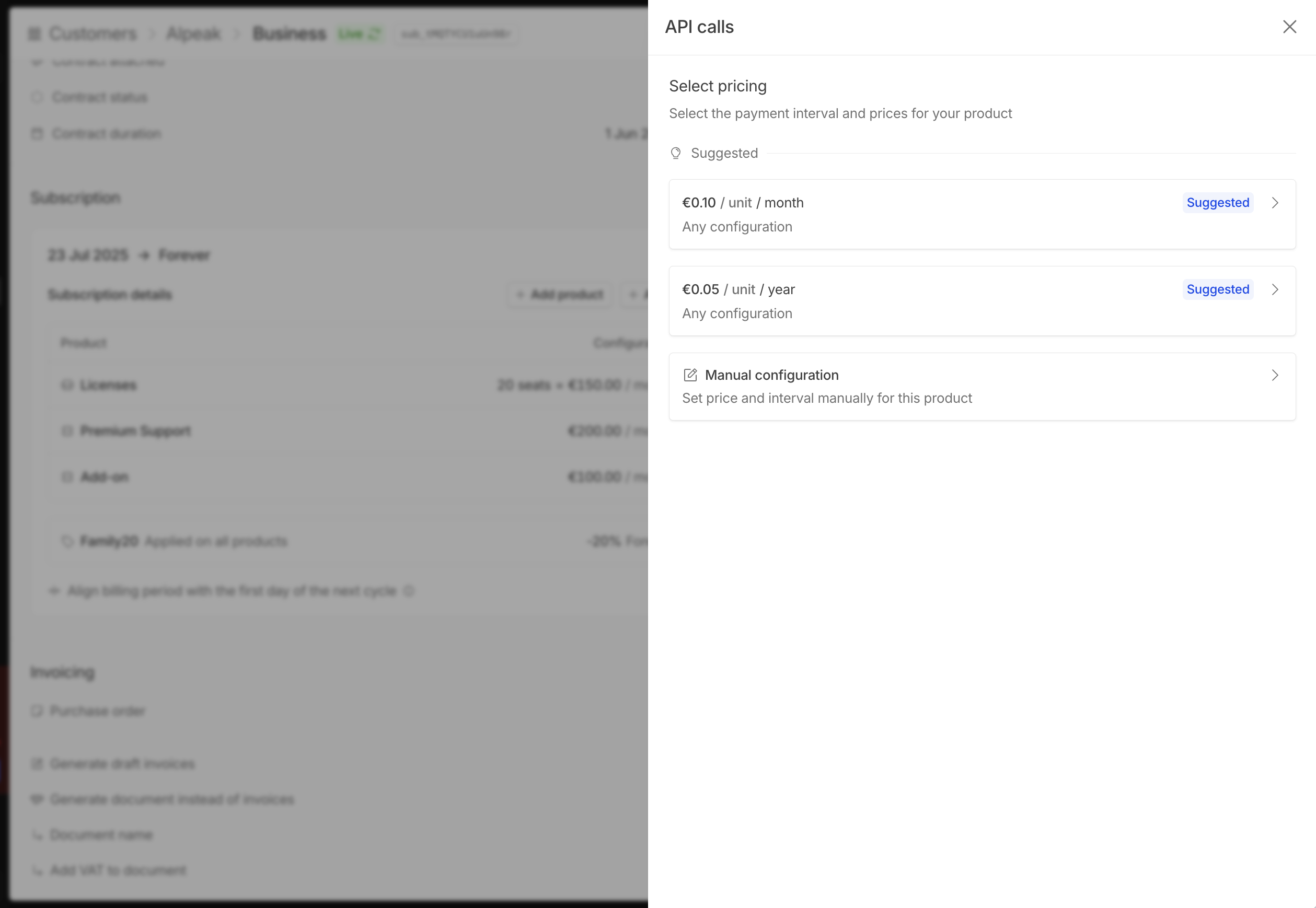
Remove product
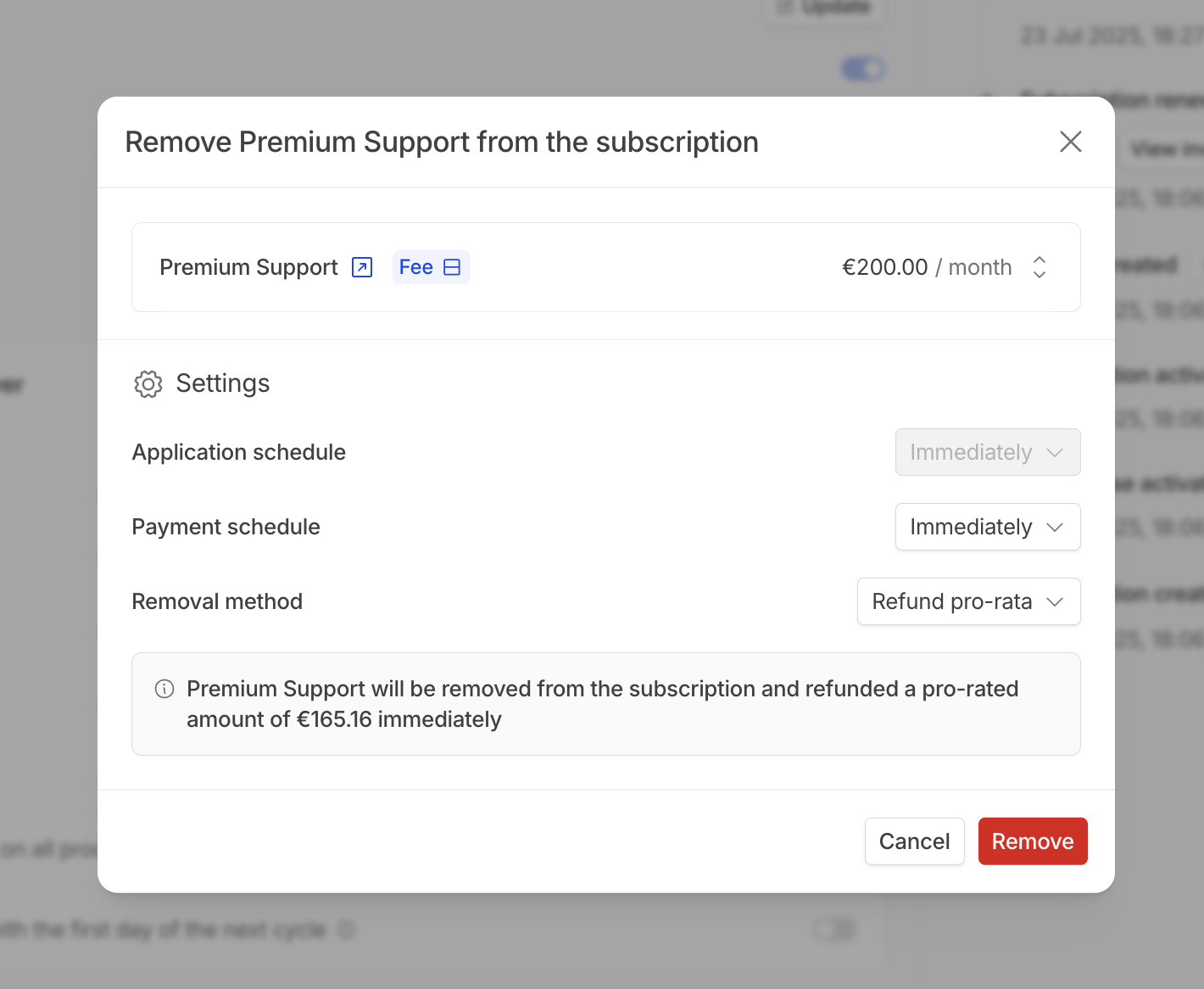
You can remove products from the subscription immediately by clicking the product... then Remove product. Depending on the product balance, you can charge or refund them at a pro-rata or full price, or without payment, either immediately or with the next invoice.
Coupons
You can add or remove coupons freely from the subscription, with immediate effect.Add coupon
You can add coupons directly to a live subscription by clicking Add coupon. You can then configure the coupon name, application, discount type and products it applies to.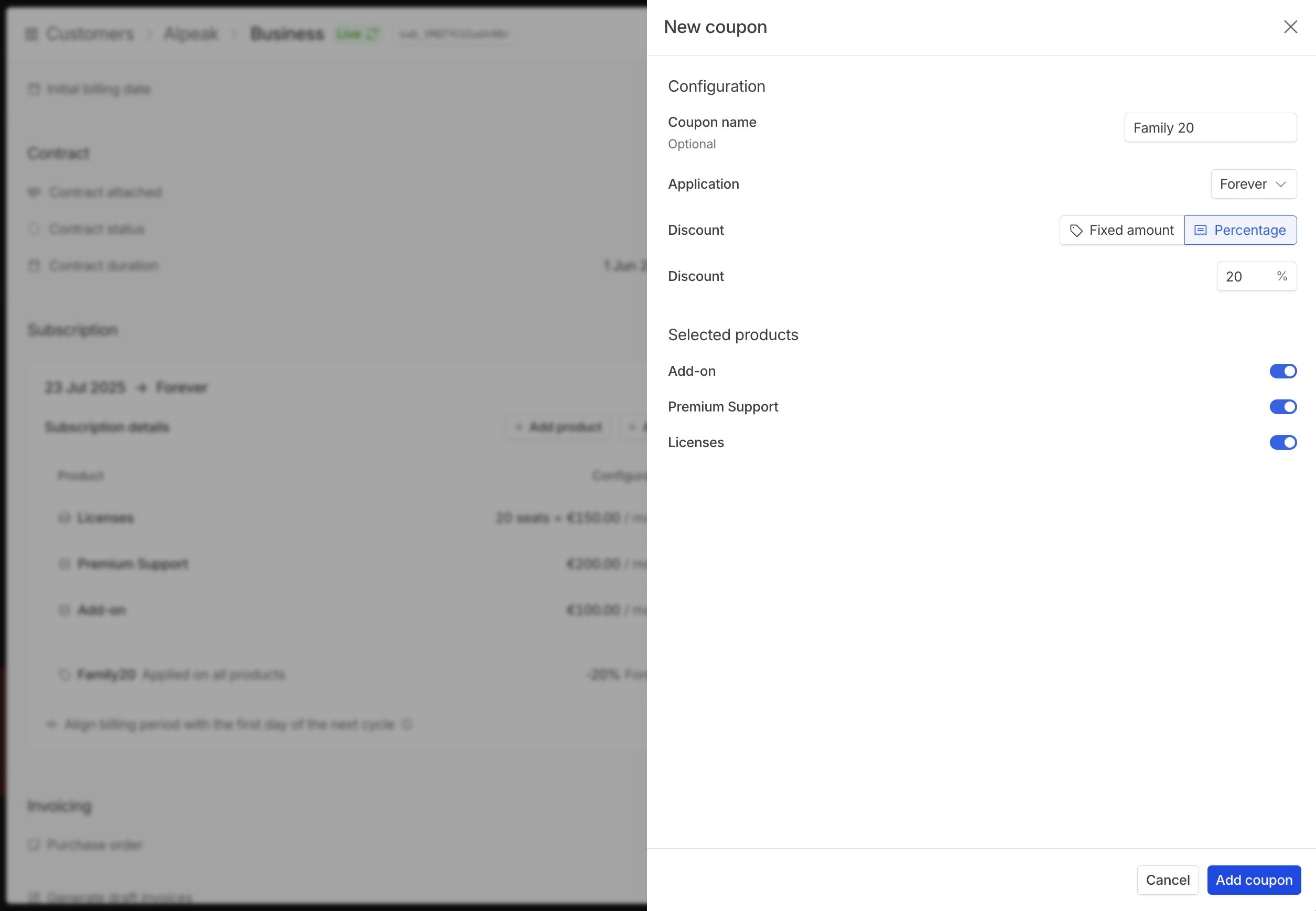
When adding a coupon with a duration (e.g., 6 months) during a subscription update or transition, Hyperline automatically calculates the coupon’s expiration date from the transition date. This ensures the coupon applies for the correct duration starting from when the update takes effect.
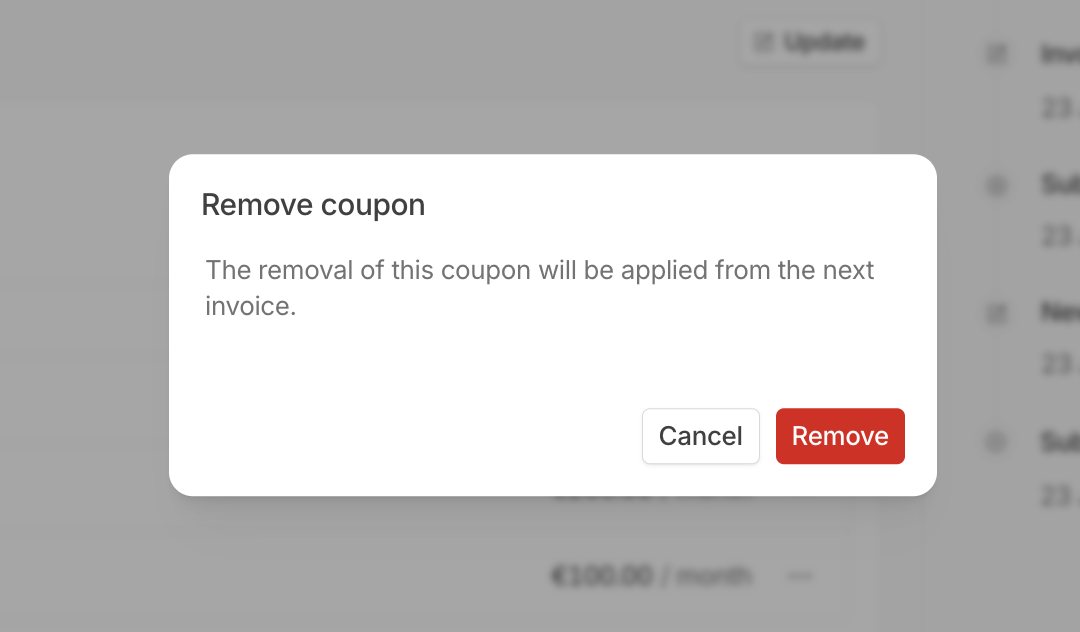
Remove coupon
You can remove coupons from the subscription immediately by clicking the coupon... then Remove coupon.
Contract
You can attach, edit, or remove a contract from the subscription at any time.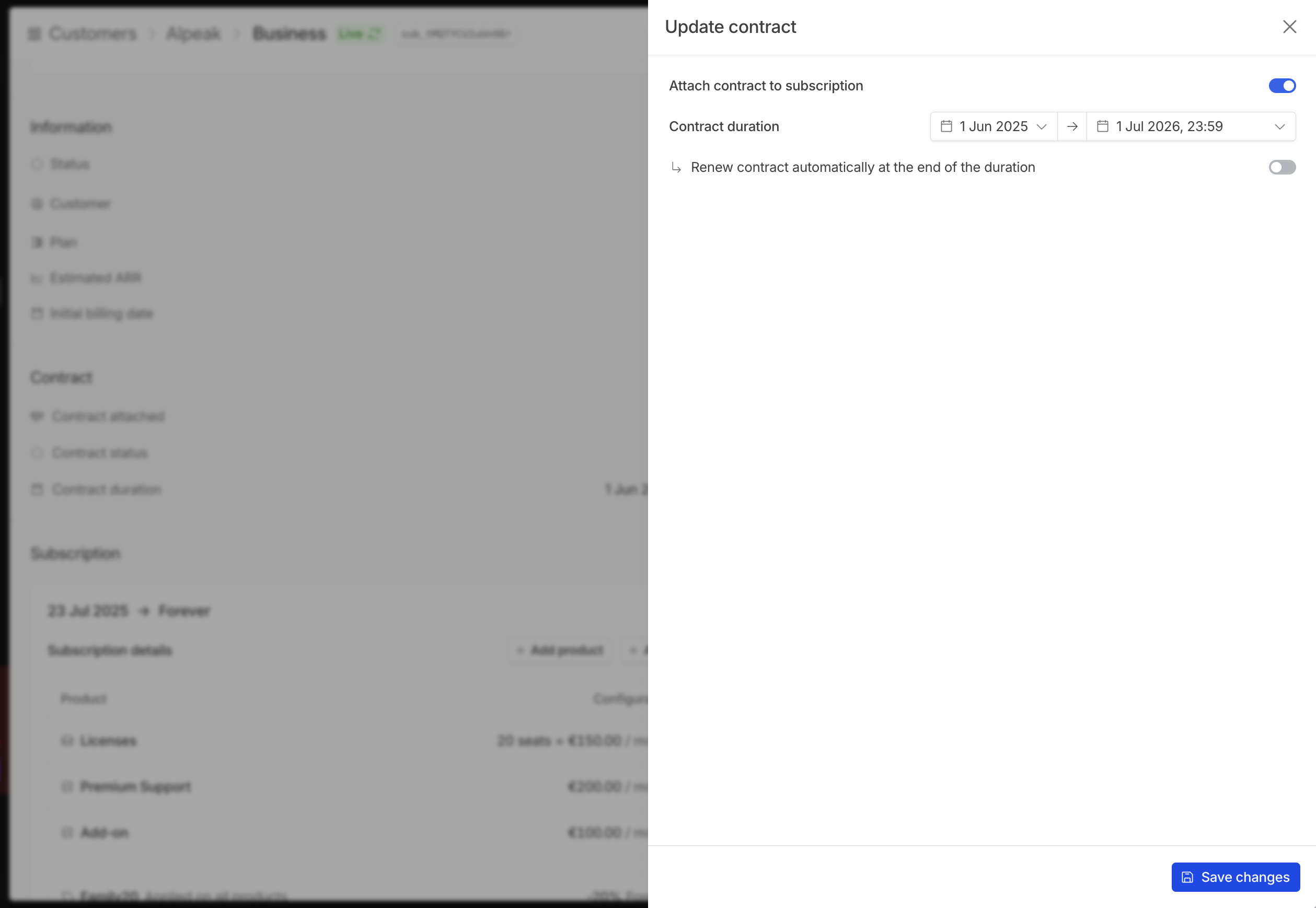
Invoicing
You can edit the invoicing configuration at any time, with an impact on invoices emitted after the update. Changing Generate draft invoices, Generate documents instead of invoices, or Do not charge subscription requires the Manage subscription invoice settings permission. Without it, these advanced options are hidden and keep their current values. The purchase order, custom invoice note, minimum fee, and invoicing schedule remain editable with the standard subscription update permission.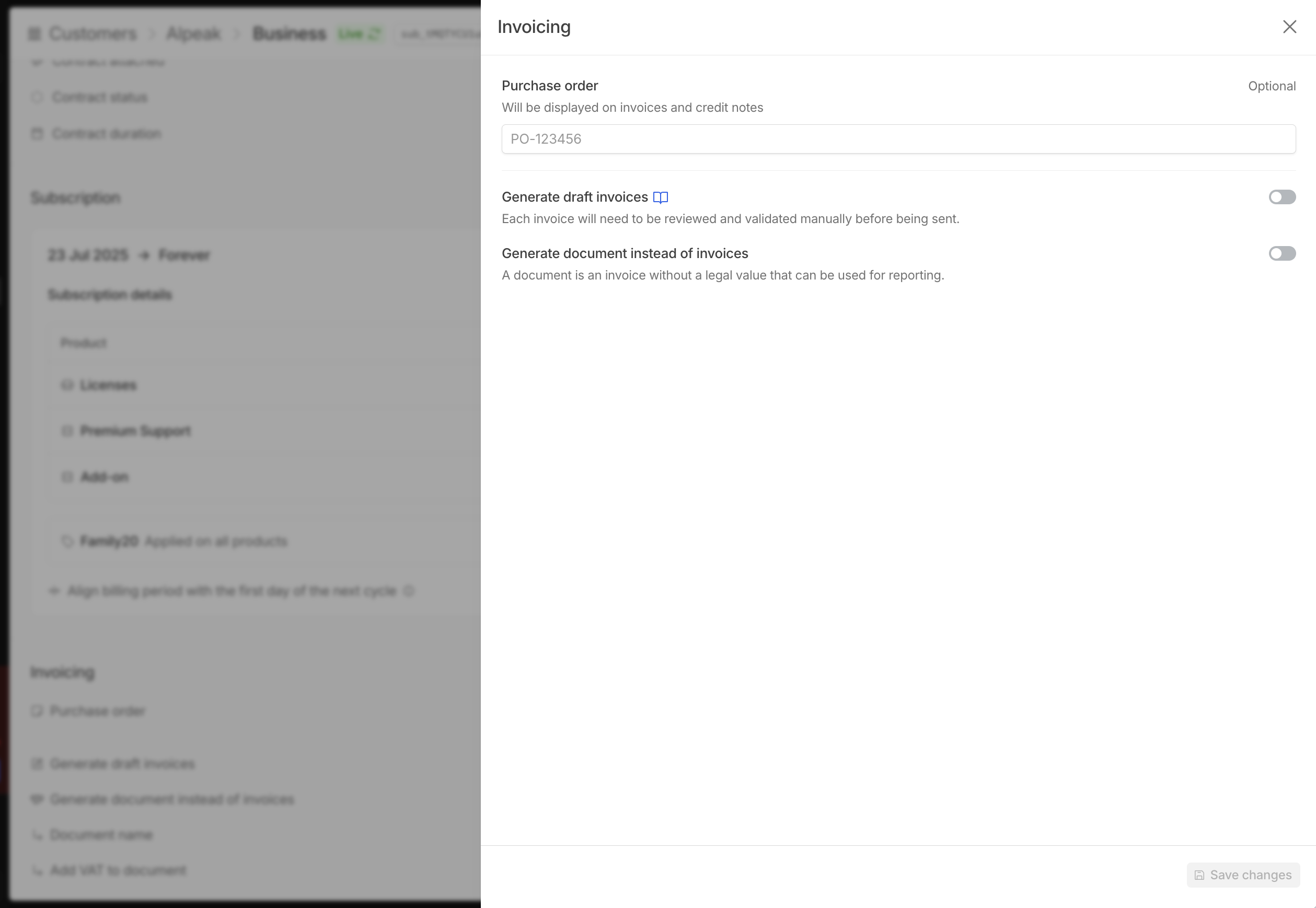
Shipping address
Shipping controls are available only when shipping details are enabled for the subscription’s invoicing entity. In the subscription’s Invoicing settings, select a saved customer address in Shipping address, then save your changes. Only shipping addresses are listed. The selected address applies to invoices created after the update and their tax calculations, including Anrok and Sphere. Existing invoices keep their original address. To remove the subscription-specific address, select Use customer’s default destination:- If the customer’s shipping destination is the billing address, Hyperline uses the billing address without a separate shipping address.
- If the customer’s shipping destination is a separate shipping address, Hyperline uses the customer’s default shipping address.