

- Credit & debit cards: Visa, Mastercard and American Express
- Direct Debit:
- SEPA Direct Debit for customers in the Single Euro Payments Area
- ACH Direct Debit (for customers with a bank account in the US & in USD)
- Bacs Direct Debit (for customers with a bank account in the UK & in Pounds)
- Bank transfers: direct bank transfers from your customers to your bank account
- Apple Pay and Google Pay
Payment service provider
Hyperline natively supports major Payment Service Providers (PSPs). This means that using these services won’t require any technical work from you, and Hyperline fully orchestrates your PSP account without extra work on your side.Configure Apple Pay and Google Pay
Enable the wallets you want to offer in your connected payment provider account, then select them in Hyperline under Settings > Payment. Domain requirements depend on your provider.Stripe
Stripe
Follow Stripe’s domain registration instructions for the domains and subdomains used by your payment pages, including your custom domain if you use one.
Mollie
Mollie
Enable Apple Pay and Google Pay on the Mollie website profile connected to Hyperline. If you connect multiple Mollie accounts or profiles, enable the wallets on each profile that will accept them. You do not need a separate Google merchant ID or separate domain registration for either wallet.Apple Pay still requires a public verification file on the exact domain shown in your customer’s browser address bar. This includes the subdomain, not just your main website domain. Google Pay does not require this Apple Pay file.If a wallet fails in your embedded page, try opening the hosted payment page directly. Contact Hyperline through the in-app chat if you need help with a custom domain or a verification file already used by another provider.
Hyperline supplies the file with the pages it serves. If you embed a page in your own website, ask the developer responsible for that website to:
- Download Mollie’s Apple Pay verification file and keep its filename and contents unchanged.
- Make it available over HTTPS at
/.well-known/apple-developer-merchantid-domain-associationon each parent-page domain you use. - Check that the URL returns the file publicly, without requiring a login or restricting access to your network. Hosting it only on the embedded page’s domain is insufficient.
app.alpeak.com and see your Hyperline form embedded there, the file must be available at https://app.alpeak.com/.well-known/apple-developer-merchantid-domain-association.Mollie has not fully validated its Express Component inside an additional iframe. Test both wallets in your actual embedded page before offering them to customers. You also need the iframe payment permission. This permission does not replace Apple Pay domain verification or guarantee wallet compatibility. You cannot fully validate Apple Pay in Mollie test mode.
Customer payment methods
Hyperline gives you fine-grained control over which payment methods are available to each customer. This allows you to tailor the payment experience and restrict certain methods based on customer-specific needs or preferences. Hyperline displays the enabled payment methods to the customer on their portal page or when using embedded components. You can configure this in two ways:- Via the Settings modal under the Payment Methods section on the customer’s page.
- While assigning a subscription to a customer, by selecting the allowed payment methods for the customer.
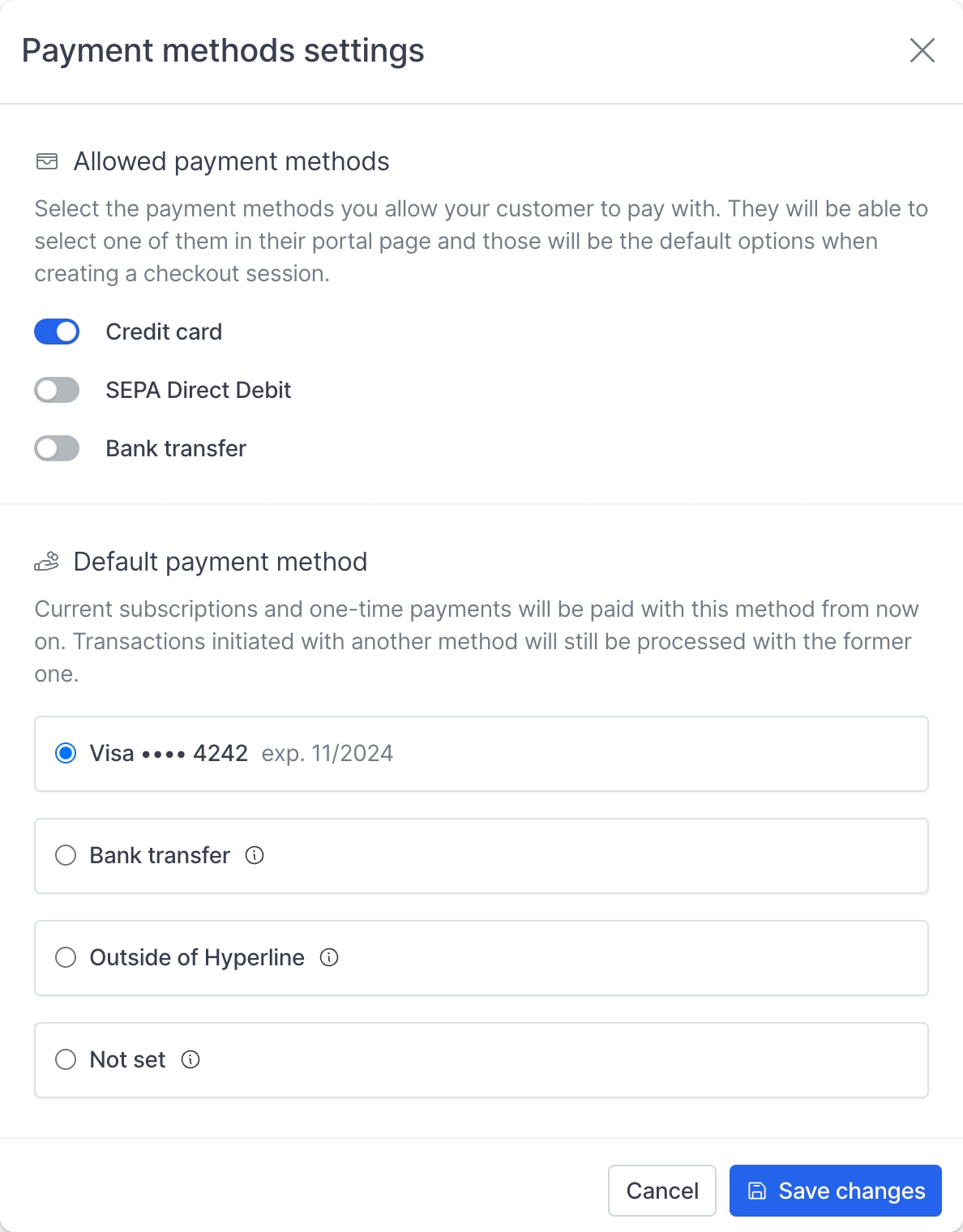
Inherit, override, or disable a method
By default, a customer’s payment methods follow the defaults configured on their invoicing entity. For each payment method, you can select one of three states:- Use default settings: the method inherits the invoicing entity configuration. The option displays the entity’s current default (payment provider or, for bank transfers, bank account) so you can see exactly what applies. When you update the entity settings later, the change automatically flows through to every customer using this option.
- Override: select a specific payment provider (or bank account for bank transfers) for this customer. The customer keeps this value even if the entity defaults change.
- Disabled: the method is not offered to this customer, regardless of the entity configuration.
Manage payments outside of Hyperline
If you prefer not to use Hyperline’s built-in payment capabilities, you can manage payments entirely outside of the system. This is particularly useful if you already operate a complex banking infrastructure or act as your own payment processor. In this case, there’s no need to connect a payment service provider (PSP). You can configure the customer’s payment method as “Outside of Hyperline”, which:- Disables all payment-related logic in billing flows
- Removes payment method sections from the hosted pages (checkout, quote, invoice) and customer portal