

Editing a quote template doesn’t impact the draft quotes created using this template.
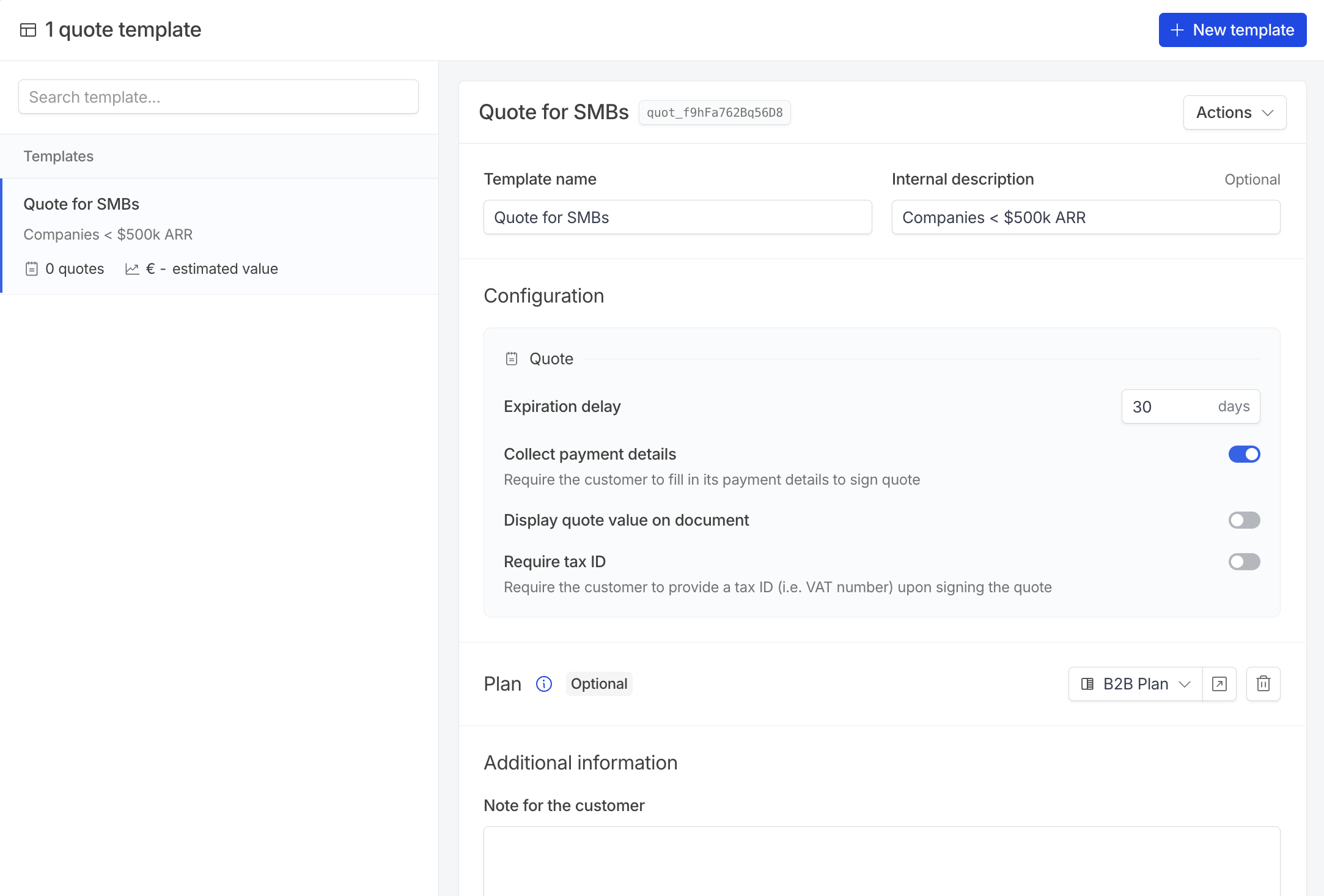
Creating a template
Quote templates are in the Quoting section, on the Templates page.1
Name the template
Add a name and optionally an internal description to make it identifiable for your sales team.
2
Configure quote details
Pre-configure the expiration delay and information required from customers to sign the quote.
3
Optionally, add subscription configurations
In Quote details, click Add configuration and select a subscription template. It pre-fills a new subscription with its contract, products, prices, coupons, and invoicing settings.When Allow multiple configurations is enabled in Settings > Quoting, you can add more subscription templates, up to 50 configurations. Select a different subscription template for each configuration. Drag the handles to set their order, open a selected subscription template to review it, or use the trash icon to remove a configuration.Template configurations support new subscriptions only. Leave them empty to reuse the quote’s terms and settings, then configure a subscription, an update, or a one-off invoice in the quote editor.
4
Optionally, configure additional information
You can add a customer note and contract terms. You can pre-fill contract terms with clauses configured in Settings > Quoting.
5
Optionally, add attachments
When sending a quote to a customer, you might want to attach a contract or your terms and conditions so they can sign both the quote and the contract simultaneously.Attachments can be:
- Added manually on the template
- Added dynamically based on the customer’s country and language through localized attachments configured in Settings > Quoting.
6
Optionally, configure display settings
Select what the quote shows, such as the first invoice amount, quote value, phase value, taxes, and Discounts on total. These settings pre-fill the quote’s Display settings. For more details, see Display.
7
Save the template
Using a template
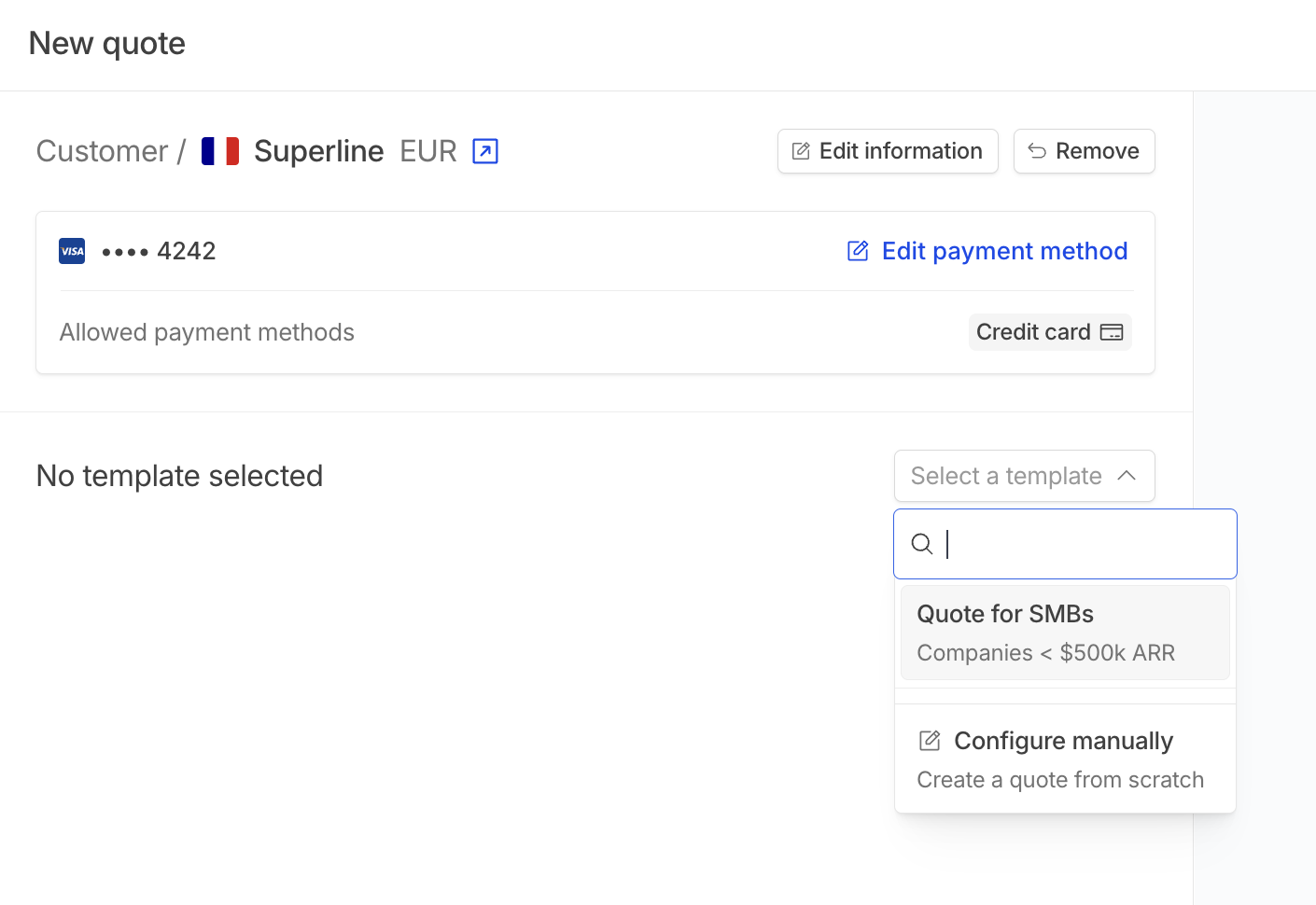
- Create a quote and select the customer.
- Select a quote template, or select Configure manually to start without one. For each linked subscription template, Hyperline selects the configuration matching the customer’s country and currency and creates a separate draft subscription, in the order saved on the quote template.
- Review the subscriptions in Quote details. You can edit or remove each one. If none were added, click Add configuration and select New subscription, Subscription update, or One-off invoice. With multiple configurations enabled, the button below existing configurations adds another of the same type. Remove all existing configurations to select a different type.
- Review the pre-filled terms, attachments, and settings before sending the quote.
If a subscription template has no configuration matching the customer’s country and currency, Hyperline skips it and displays a warning. The quote still includes the other matching configurations. Review the warning and complete any missing subscription before sending the quote.
Localized attachments
If your team frequently sends quotes with the same contract details, manually attaching files can become time-consuming, especially for sales teams that may struggle to select the right templates. With localized attachments, you can configure attachments that Hyperline adds automatically based on the invoicing entity, country and language of the customer.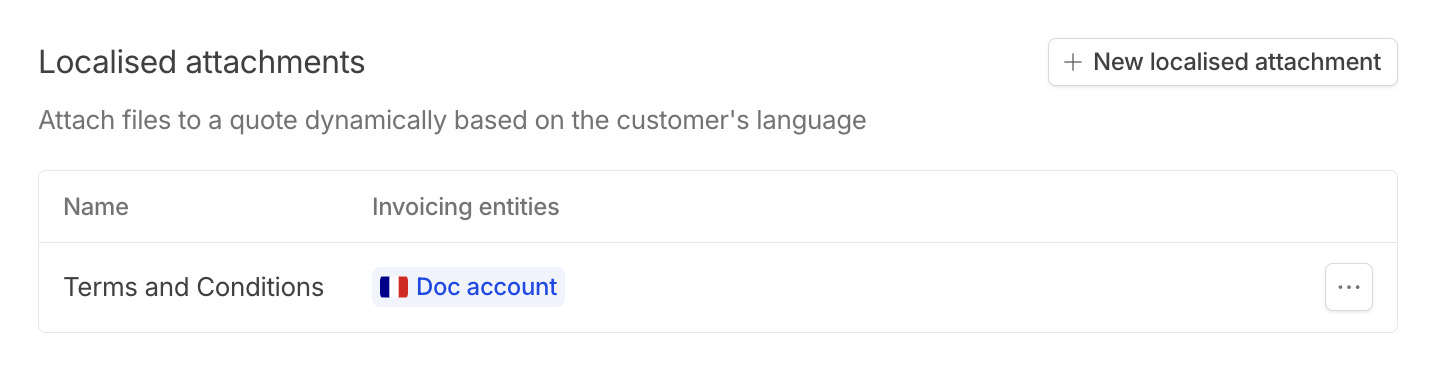
1
Create a localized attachment
Give it a descriptive name and select the eligible invoicing entities. Attachments are only available for customers linked to the selected entities.
2
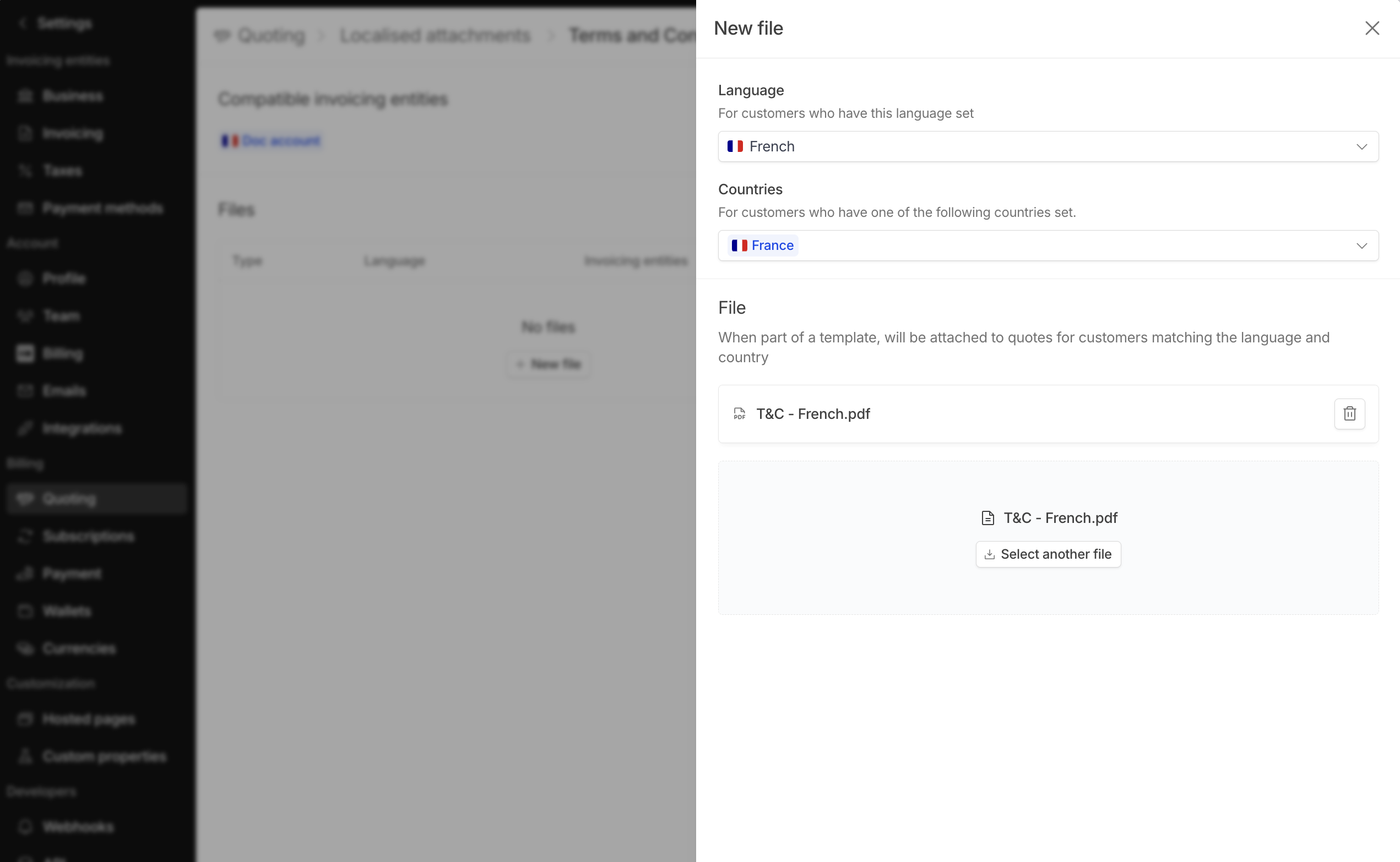
Add documents
3
Accepted formats
Each document must be in one of the following formats:
PDF, DOC, DOCX, PPT, PPTX, or TXT, with a maximum size of 5 MB per file.Clauses
Clauses are a lighter version of localized attachments. They let you add dynamic text to the Contract terms field based on the invoicing entity and the customer’s language.You need the Contracts read permission to view and use contract clauses in the quote editor. Without this permission, the clause insertion options aren’t available. Learn more about user roles and permissions.
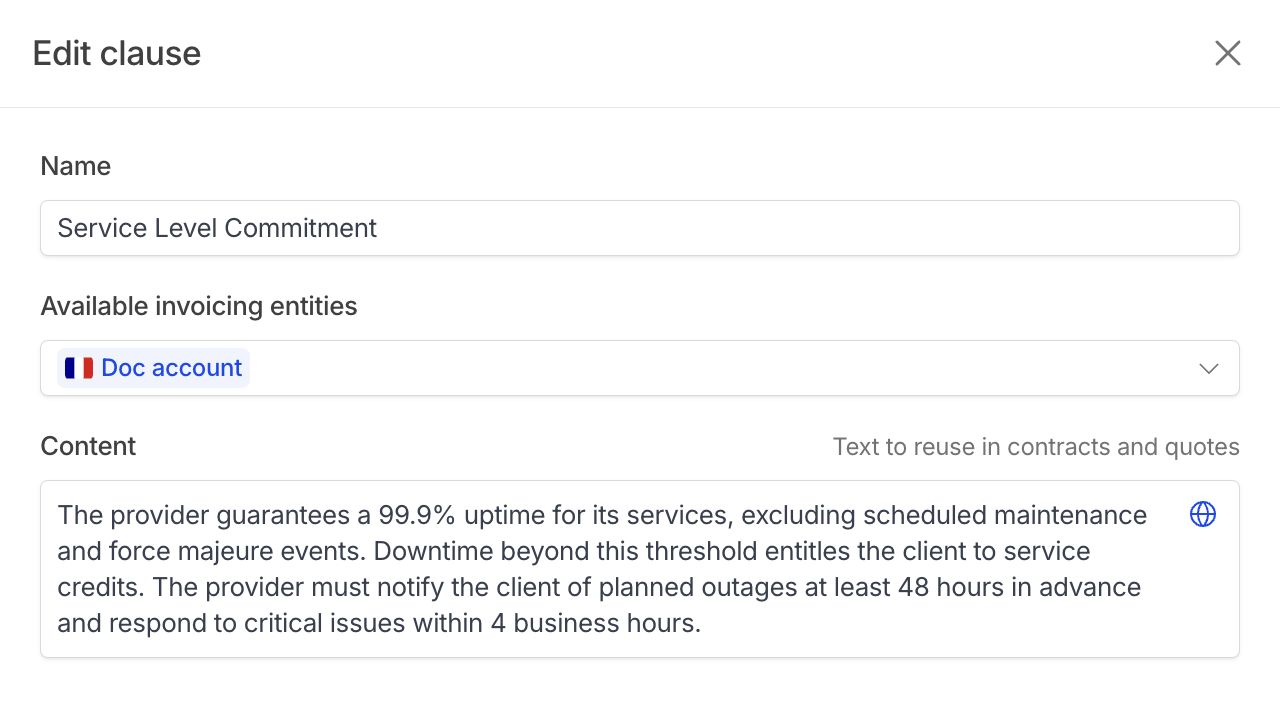
1
Create a clause
Give it a descriptive name and select the eligible invoicing entities. Clauses are only available for customers linked to the selected entities.
2
Add content
Enter content in the text area. You can add alternative versions for different languages by clicking the blue globe icon. If you don’t set translations, Hyperline adds the default version.
Links and legal terms
Quote notes and contract terms support Markdown formatting. To add a clickable legal link, write the label in brackets and the URL in parentheses:- Quoting > Settings > Legal information, where you set the legal information printed on every quote of an invoicing entity.
- Quoting > Library, where you manage reusable clauses.
- Quote templates, where you pre-fill the terms used by quotes created from that template.
Quote legal information
Quote legal information is the text Hyperline prints at the bottom of every quote, such as your company’s legal form, share capital, or registration number. You set it per invoicing entity, and each quote uses the text of the invoicing entity it’s issued from.- Go to Quoting > Settings and scroll to Legal information. The table lists the invoicing entities that already have legal information.
- Click Configure and select an invoicing entity, or click a row in the table to edit an existing text.
- Enter the text. To add a version per language, click the globe icon. Hyperline uses the customer’s language when it generates the quote, and falls back to the default version.
- Click Save changes.
{{customerId}}, {{customerExternalId}}, {{quoteNumber}}, and {{invoiceId}}, plus customer and subscription custom properties.
Quote legal information used to be in the Quotes tab of each invoicing entity’s Invoicing settings. Existing texts were kept as they are. You need the View invoicing entities settings permission to see it, and Manage invoicing entities settings to change it. Learn more about settings permissions.