

If you use Customer Intelligence, a monitoring agent can optionally include descendant customer context when analyzing a parent customer. This affects the health analysis only and does not change invoice routing or organisation-based billing settings. See Analyze a parent with descendant context.
Activate organisation-based billing
1
Navigate to the Customers page
2
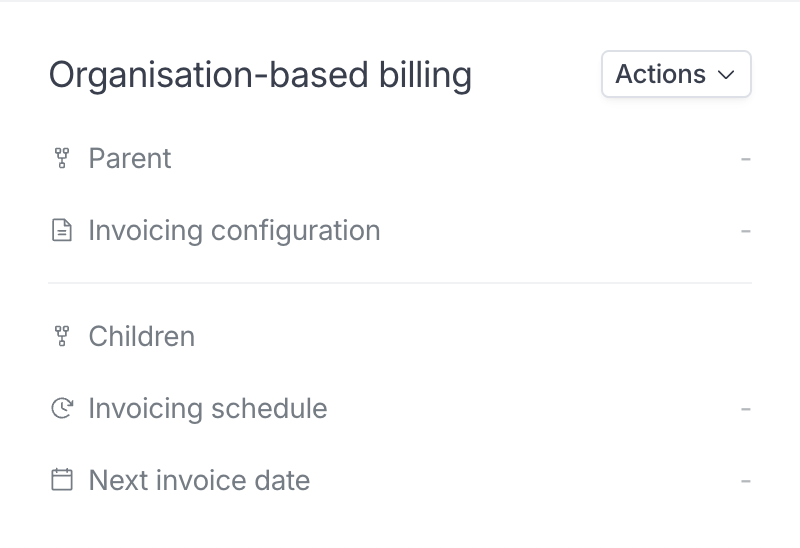
Click the 'Actions' button in the bottom left of the page
3
Available information
Here, you can see the parent/children relationship and the invoicing
configuration for this customer.Click Set parent organisation to select a parent organisation for this customer.
4
Configure the invoicing settings for this customer
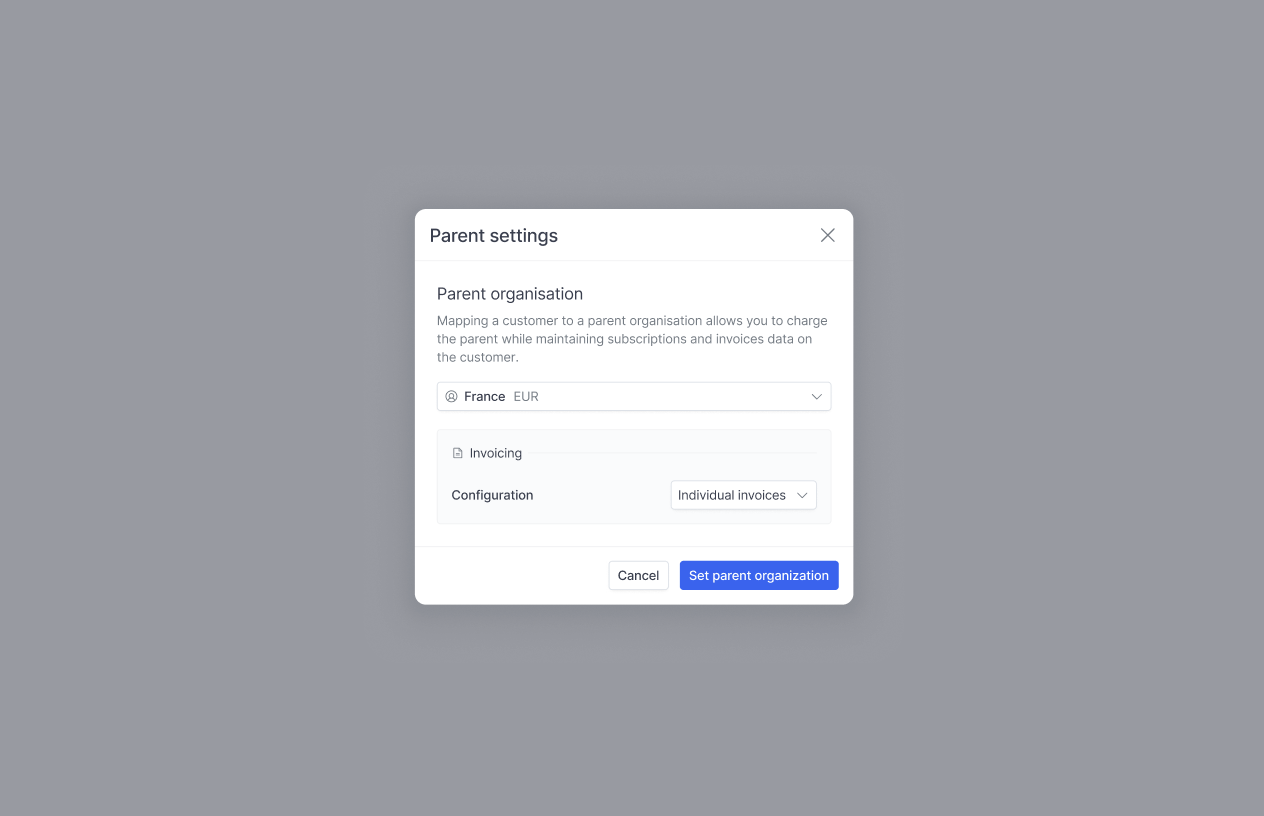
- Individual invoices creates a separate invoice on the parent for each child invoice, using the parent’s billing details and preserving the child’s shipping details.
Groupedsets the current customer’s invoices as pending and regularly combines them with invoices from the parent’s other children. Combined invoices display one line item per child invoice with the original line items listed in the description.No changeattaches the child to the parent but doesn’t change any invoicing parameter.
5
(Optional) Set the parent invoicing schedule
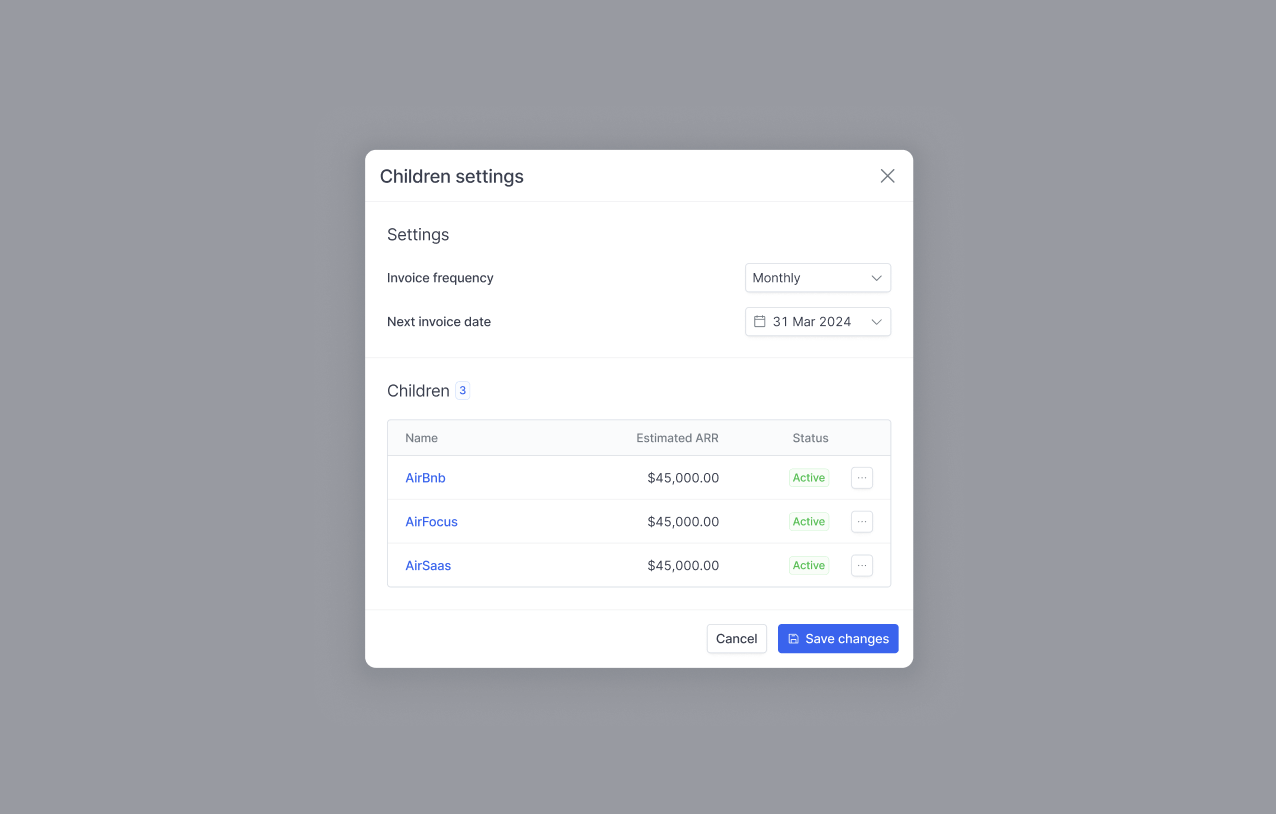
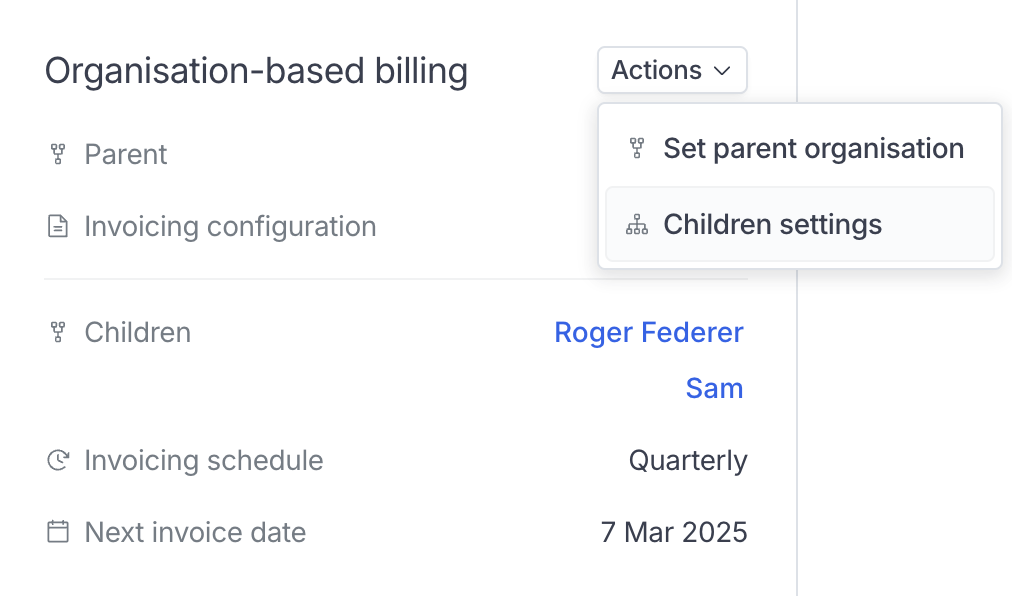
Grouped for the child invoicing configuration, you’ll need to set the grouping schedule on the parent.To do this, go to the parent customer page, click the dots next to Org. based billing and select Children settings.You can select a schedule (monthly, quarterly or yearly) and the next invoicing date. From there, Hyperline automates everything, but you can adjust the next invoicing date at any time.6
(Optional) View the children settings
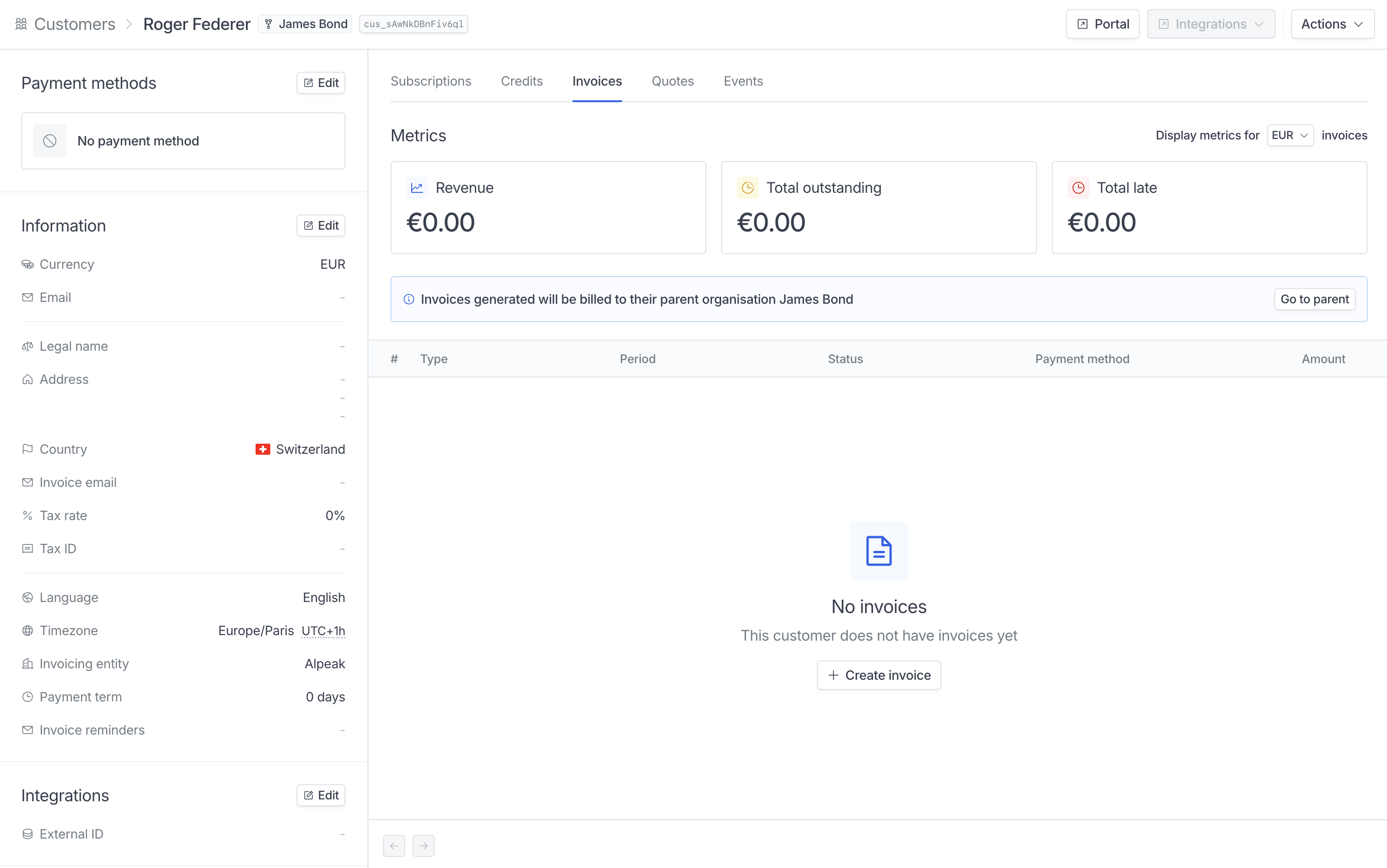
Precisions on organisation-based billing
Payment methods If you bill a customer through a parent, Hyperline uses the parent payment method configuration to process the payment. For example, if the child customer is connected to Stripe and has a credit card on file, Hyperline doesn’t use it. Billing and shipping addresses Parent invoices use the parent’s billing address. Shipping details depend on the invoicing configuration:- Individual invoices: the parent invoice keeps the shipping details recorded on the child invoice, including a subscription-specific shipping address. You don’t need to save the child’s address on the parent. Later changes to the saved address do not change the details copied from the child invoice.
- Grouped: the combined invoice uses the parent’s shipping configuration. It does not copy or combine the children’s shipping addresses. Choose Individual invoices if each child’s shipping destination needs to appear on its parent invoice.
- For
Individual invoicesconfiguration: if the child subscription has draft invoices enabled, Hyperline creates the parent invoice as a draft. - For
Groupedconfiguration: if any child subscription has draft invoices enabled, Hyperline creates the merged parent invoice as a draft.
Charged on parent.
If a child invoice is pending a parent grouped invoicing, it has the status Pending parent concat.
Track line item origins
For Grouped configuration, parent invoices include an original_line_item_id field on each line item, allowing you to trace which child invoice each line item originated from via the API.
Consumption exports
When Hyperline charges child invoices to the parent, exports can include the child usage and machine-level consumption data. However, they do not expose a per-line euro amount for each child consumption line. Use the parent invoice lines for the billed amounts and the consumption export for the underlying usage detail.
Invoices that can’t be grouped
For Grouped configuration, a child invoice can only be rolled up onto the parent if its invoicing entity matches the parent’s. When it doesn’t, Hyperline blocks the regroup for that invoice and surfaces a red callout on both the parent and the child customer overview.
The callout links to a Sentinel task listing the affected invoices. Review them and align both the invoice’s invoicing entity and the customer’s invoicing entity with the parent’s. Once aligned, the invoice becomes eligible for regrouping again.
Remove a child company from its parent
To remove the child company from the parent, open the modal where you linked them and click the red button. Any future invoice then stays on the child.
Invoices with the status Pending parent concat move back to the child for processing.